V.
THE CAMPAIGN OF 1815
Chapter 1.
French Forces—Creation of the Standing Army
When Louis XVIII left France, the army was by some accounts115,000 men strong. [52] Bonaparte states that the number of men under arms was only 93,000.[53] On the 1st of June [1815], after ten weeks had passed, the army consisted of 217,000 men. Thus even if we accept the lowest estimate for the royal army as accurate, the actual increase in size amounted to only 124,000 men. While Bonaparte claims that there were also another 150,000 men in depots on the 1st of June, these were obviously not yet organized, because he certainly took all forces that were in any way useful directly to the battlefield.
There could not have been a shortage of manpower, that is to say trained soldiers, because if you add together what Bonaparte had available when the war ended in 1814—the army in Spain and opposing Wellington [on the frontier], the troops in Italy and the Netherlands, and all the fortress garrisons—the French army must still have contained at least 300,000 men. 100,000 prisoners of war definitely came back from captivity, so it seems that Bonaparte could have disposed of more than 400,000 veteran soldiers in 1815.
There was also no shortage of weapons, as can be seen by the fact that 150,000 members of the National Guard received arms. Furthermore, the arrangements that Bonaparte made for increasing arms production provide little reason to believe that such a shortage existed. Equally implausible is the assumption that there was not enough cash available initially. One must therefore recognize that, apart from the time required for training, there are definite limits to how fast armed forces can be raised, which are more constrained than they might appear at first glance.
For example, at the end of 1813, after Bonaparte saw his army destroyed at the Battle of Leipzig, replacements over the next three months amounted to only 150,000 men. Going back even farther, we find that at the beginning of 1813, when Bonaparte was almost the only one to return from the army that had been shattered in Russia, the increase in size of his forces from then until the armistice—a period of seven months—was only around 200,000 men. [54] When considered in relation to the population and strength of France, these increases are quite modest. One must therefore be careful about crediting even the most energetic government—and Bonaparte's can certainly be counted as such—with the ability to mobilize huge numbers based solely on population and wealth. The situation is different with a Landwehr system,[55] or whatever other name one gives it, for which we can take the arming of the French nation in 1793 and 1794 as an example.[56] It is well known how the French fielded such overwhelming masses of troops at that time.
Our own example is similar. At the beginning of 1813 our standing army was 30,000 men strong, and at the time of the start of the campaign in Saxony around 70,000. The increase in size was thus 40,000 in three months. In contrast, the increase by using the Landwehr from that time until the end of August—a period of around four months—was approximately 150,000. It therefore seems certain that a centralized administration like that of a standing army has much greater difficulty equipping exceptionally large forces within a limited period of time than do provincial administrations spread across the entire country, as long as these act simultaneously and with the necessary zeal. Overall the main characteristic of a Landwehr system in wartime is that it is subject to far fewer limitations than a simple expansion of the standing army, no matter how the latter is done.
Chapter 2
Depots and the armée extraordinaire
In addition to the 217,000 men that Bonaparte had under arms on 1 June, there were by his own account another 150,000 men in depots. He does not say how many of these were incorporated into the army or at what times, and it seems that up to midJune—thus at the decisive moment—no substantial numbers had entered.
In addition he lists an armée extraordinaire supposedly consisting of 196,000 men, mainly militia and naval troops, who were intended to garrison France’s ninety fortresses. It is not certain if these 196,000 men were actually armed. He labels them “effectives,” but because he also uses this term for the 150,000 men in the depots, it remains unclear how many of those 196,000 men were actually under arms.
The large number of fortresses could have swallowed up great masses of troops, but judging by the numbers of armed troops we actually encountered when we entered France, there is good reason to doubt the reality of those figures. According to them there should have been 217,000 men on the frontiers plus another 350,000 men inside France, including those in the depots. However, many of the 90 fortresses were either not garrisoned at all or only lightly manned, as can be concluded from the example of Strasbourg, since Rapp[57] had to throw his whole corps into it in order to be able to defend it. Furthermore, the entire French army in Paris and afterwards behind the Loire was not more than 80,000 men strong, of which at least 40,000 had come from Bonaparte's main army, so the reinforcements could not have amounted to more than 40,000 men. [58] All we want to point out with these figures is that when Bonaparte says that "on June first I had 560,000 men under arms," one should not regard this as a solid fact. If he had actually had such numbers, it would certainly have been poor economy of force for him to bring only 126,000 men with him to the decisive battle on 16 June. The only certainty is that he had 217,000 troops opposing the enemy. The force that was behind the army and in the interior of the country in fortresses may not have been negligible, but as the results prove it was also not sufficient to provide a reliable source of support after a total defeat.
Chapter 3
Bonaparte's Boasting about His Resources
In the end, Bonaparte claims that he would have increased his forces to around 800,000 men by the 1st of October. But if we already have reason to doubt the previous numbers, this is even more the case with those 800,000 men. One cannot ignore the fact that the author of the Memoirs enjoys expounding upon his tremendous efforts and on this occasion—as on so many others in his works—does not stick very closely to the facts. Bonaparte and the authors who support him have always attempted to portray the great catastrophes that befell him as the result of chance. They seek to make their readers believe that through his great wisdom and extraordinary energy the whole project had already moved forward with the greatest confidence, that complete success was but a hair's breadth away, when treachery, accident, or even fate, as they sometimes call it, ruined everything. He and his supporters do not want to admit that huge mistakes, sheer recklessness and, above all, overreaching ambition that exceeded all realistic possibilities, were the true cause.
If we confine ourselves to an overall impression of the situation, then Bonaparte seems like a land speculator who pretends to be richer than he actually is. He did not have much more than a couple of hundred thousand men available, and he tried his luck with them. Had he succeeded in overthrowing the coalition, or at least in securing France ’s borders, then afterward—while still far from having increased his strength—he would have revealed the miserable performance of his opponents by showing how his incomparable boldness had enabled him to accomplish so much with so little. But now that the attempt has failed, and actually seems to have been impossible all along, he does not want to look like a reckless adventurer. Instead he says his preparations were colossal and claims that the French people were making tremendous efforts for him out of enthusiasm and devotion. These are entirely natural expressions of his great vanity and low regard for the truth, but this side of his character reduces his significance as a writer of history far below that of other military leaders whose memoirs have become a primary authority for historians.
We are not wasting time here in some useless speculation, because our evaluation of the strategic relationships of this campaign would be completely different if we could truly believe that Bonaparte had been so confident in the French people, and so successful in all of his preparatory measures, that he might actually have achieved the results that he presents: to have 800,000 men under arms and abundantly provided with all necessary equipment within three months; also Paris and Lyon fortified, the former with 116,000 men and 800 guns, the latter with 25,000 men and 300 guns. Even if the Allies did not actually give him all three of the months he needed to complete this project, namely July, August and September, he still would have drawn closer to this great goal with every month that passed. It could therefore be predicted that if the Allies had advanced toward Paris in July, they would have encountered defensive forces that—in conjunction with the loss of strength that every strategic offensive suffers as a result of the need to secure its lines of communication—would have sufficed to bring the operation to a standstill, and thereby gradually led to the involvement of the entire populace. This would naturally have given the French a far greater chance of success than they had with the offensive that Bonaparte actually undertook. But if all of Bonaparte's numbers are more or less empty boasts, if he did have to rest his hopes for a new start solely on an army of 217,000 men, then perhaps this offensive was so obviously the only possible means of resistance that nothing else could even have been considered.
Chapter 4
Dispositions of the Army
The 217,000 men that Bonaparte had under arms at the beginning of June were divided into seven army corps, a Guards corps, four corps of observation,[59] and an army corps for the Vendée.[60] After deployment they consisted of the following forces:
1. The main army opposite the Netherlands
The Imperial Guard and five corps 130,000
2. On the Upper Rhine 25,000
a) 5th Corps at Strasbourg under Rapp 20,000
b) 1st Observation Corps at Hüningen under Lecourbe 5,000
3. Opposite Italy 22,000
a. 7th Army Corps at Chamberi under Suchet 16,000
b. 2nd Observation Corps in Provence under Brune 6,000
4. Opposite Spain 8,000
a. 3rd Observation Corps at Toulouse under Decaen 4,000
b. in Bordeaux under Clauzel 4,000
5. In the Vendée under Lamarque 25,000
Total 210,000
which does not correspond exactly with the number of 217,000 men, but the difference is not significant.
The Army aimed at the Netherlands was originally supposed to be 20,000 men stronger, but these were sent to the Vendée to deal with the immediate threat that had appeared there.
To be sure, Bonaparte had thereby concentrated his forces to a high degree against Blücher and Wellington, because he opposed the 220,000 Allied troops facing him on this front (which represented about one-third of the total enemy strength) with 130,000 men, that is to say more than two-thirds of the total forces he had available to place on the borders. Nevertheless, one is tempted to say that he, the great master of the art of concentrating his strength at the decisive point, had fragmented his forces in this case. The troops on the Upper Rhine and those facing Italy and Spain were obviously insufficient even to pretend to defend the rivers and mountains that lay before them, yet they were not absolutely indispensable merely for garrisoning the fortresses. And considering that, out of the 55,000 men stationed on the borders, Bonaparte might have gained another 20-30,000 for the main army if he had immediately abandoned [his efforts to control] the countryside, then it seems like a huge mistake not to have made the utmost efforts to assemble all of his strength at the decisive point. For in a position such as his, this seems like the only thing that could have saved him. There is no doubt that another 20-30,000 men in the battles of 16 and 18 June could have made a great difference, although one must still not assume that this would have guaranteed a French victory.
However, if we put ourselves in Bonaparte's position when he was forming and equipping his forces, we must step back from such a judgment. In analyzing strategy the main thing is always to put yourself precisely into the position of the individual who had to take action. This is often very difficult to do, of course. The vast majority of strategic criticisms would either disappear completely or be reduced to minor, theoretical differences if writers would want or be able to analyze all situations in such a manner.
Since Bonaparte was preparing to oppose all of Europe, he naturally had to consider the defense of all of his borders. He therefore placed small portions of his standing army on the borders of southern Germany, Italy, and Spain in order to form hubs around which newly raised forces could form. They were the cadres for the corps he intended to create there. When he gave these orders, there was no way he could predict in which particular week hostilities would be started by one side or the other. Nor could he know just how far his various rearmament measures would have proceeded. While he could generally foresee that his efforts would never enable him to assemble enough forces on the Upper Rhine to oppose the expected main enemy army there on anything like equal terms, he could still hope that a substantial force there would at least cause the usual initial delays, uncertainty, and caution found at the opening of any campaign, thus gaining time and slowing the enemy advance so that he would have time to hurry there with his victorious main army from the Netherlands. We are not merely speculating that he saw the situation like this, but have taken it from his memoirs. It makes a big difference whether or not a border is completely devoid of forces to defend it, especially when rivers and mountains pose an obstacle to the attacker, as is here the case with the Vosges, the Rhine, the Jura, the Alps, and the Pyrenees. If there is absolutely nothing in a province, then even the most indecisive, ponderous opponent, even the hundred-headed headquarters of a coalition army, is practically forced to advance, instead of being provoked by resistance into Daun-like caution.[61] Thus even the smallest force can cause substantial delays and indecision.
Another reason why Bonaparte could not consider completely stripping his eastern borders of troops was the impression this would have made on the French populace. He would thereby have been seen as giving up half of the Empire, thus exposing the complete weakness and uncertainty of his position. This would have had serious repercussions among the political parties in the country, as well as for the results of the rearmament effort. One could even go so far as to say that he would have been forced to keep troops in most of provinces in order to guard against the possibility of royalist uprisings. Finally, one should not overlook the fact that under the original plan the main army was supposed to have been 20,000 men stronger, and that the emerging danger in the Vendée forced Bonaparte to send some of the troops intended for the main army back to the Loire.
In mid-June the circumstances were such that he faced a force of 220,000 under Blücher and Wellington in the Netherlands, against which his 130,000 men had little likelihood of success, and on the Upper Rhine he could oppose the large [Austro-German] army of Schwarzenberg with just 30,000 men, even including the sixteen National Guard battalions he sent to Rapp. Bonaparte may well have wished he could completely eliminate the inadequate forces on the other borders in order to have a greater chance, or better yet complete certainty, of success in the Netherlands, but it was no longer possible to change all this at the last moment. He therefore had to try his luck with the 130,000 men that he had on the northern border.
Chapter 5
The National Guard
The actually arming of the people, that is to say the establishment of the National Guard, deserves a closer look.
In April Bonaparte had the idea of arming all male inhabitants between 20 and 60 years of age and organizing them into more than 3,000 national guard battalions, which would have given him over two million combatants.
This gigantic concept was unquestionably less than sound. It required three main elements: the unity of the people, enthusiastic energy on the part of his supporters, and the necessary equipment. It does not take much to see that of these three elements, the first was not present at all, the second only in insufficient quantity, and the third was even farther from being able to satisfy such an extravagant requirement.
It is not just this expanded mobilization that we must consider illusory, but also any sort of general arming of the population. This was not possible under the circumstances. Bonaparte most definitely felt this. He conceded as much when he spoke of the necessity of reducing the 44,000-man strong Parisian National Guard to 8,000 men, and spoke instead of increasing the 15,000 light infantry of the Parisian suburbs to 60,000. The situation in the Vendée and in the south also shows clearly that the cooperation of these departments could not be counted on. Bonaparte writes that even the mood in the northern departments was poor and unreliable.[62]
The result was that he limited his entire program of arming the people to just 248 elite [National Guard] battalions with a total strength of 150,000 men.
Of these, 16 battalions were sent to strengthen General Rapp, 16 battalions to General Suchet in the Dauphiné, and finally around 20,000 men to Bordeaux and Toulouse. Thus approximately 40,000 men of the National Guard were deployed in the field. That leaves around 110,000 National Guardsmen who—along with naval troops, veterans, voluntarily reenlisted retirees (mostly officers and non-commissioned officers), and finally individuals still in the depots—made up the fortress garrisons and all the other forces located in the interior of the country.
Chapter 6
An Attack On the Allies in April
Bonaparte asks himself if on the 1st of April he could and should have taken all troops available at that time and attacked the Allied forces located in Belgium and on the Rhine. Three factors, he says, forced him to abandon this idea.[63]
1) In the north he had only 35,000 men available. In order to advance with this force into Belgium he would have had to strip bare all of the fortresses in the northern provinces. However, sentiment there was too unfavorable for them to be left to their own devices.
2) He did not want to appear to be the aggressor.
3) The Bourbons were still fomenting unrest in the south and west, so it seemed essential to him to force those princes to leave French territory and nip the internal war in the bud.
While the nature of Bonaparte’s position makes the second reason seem like an illusion, a kind of legal pretense, the other two reasons seem quite compelling.
His failure to conduct such a precipitate attack is often seen as one of his great mistakes, but if one examines such an attack from the standpoint of the Allies, there is even less reason to believe that it could have been fruitful.
On April 1st the English-Hanoverian army under the Prince of Orange numbered 20,000 men and the Prussian army under General Kleist 50,000. Wellington arrived from Vienna early in April, and Bonaparte had always had to reckon with this possibility. In some circumstances, 70,000 men under Wellington and Kleist might have been driven off by 35,000 men under Bonaparte. But it is completely unreasonable to assume that he could have dealt them a decisive defeat and smashed their armies. On the contrary, that would have been the most unlikely outcome of all. If Bonaparte's success against these two leaders had consisted simply in forcing them to give up part of the Netherlands, then such a result would not have been in any way decisive. Even gaining the Belgians—if that had been so certain as Bonaparte believed—would not have added much weight to counterbalance the overall situation.
Nothing is more important in strategy than ensuring that the forces that are to carry out an attack are not used in vain, that is to say, that they are not merely thrust into the air. But that is basically how an operation against Wellington and Kleist would have to be viewed, even if it had been successful.
Of course, when one considers only the force ratio of 35 to 70, there was no reason for Bonaparte to expect better odds at a later time. Yet the issue is not just the likelihood of victory, but also its impact. It is clear that a victory over one-tenth of the enemy’s forces cannot be as decisive as one over a third of them. But if even a victory over this third (assuming that he won the Battle of Belle Alliance)[64] would still have left Bonaparte’s ultimate success very much in doubt, then it is impossible to see how an unimportant victory such as one over Wellington and Kleist could have brought significant results.
Thus Bonaparte correctly abandoned the idea of falling on the Allies at the very first moment, and instead waited for a time when a force would be gathered against him that would be worth the effort of defeating.
Chapter 7
Defense
Bonaparte also raises the question of whether he should have remained on the defensive, or instead attacked a portion of the Allied forces before they had all assembled, so as to place himself in a favorable position from which to claw at them, so to speak, later on.
However confident he may have been about his rearmament efforts, he foresaw that before he could complete them, an enormously superior force would advance against him. He personally believed that 600,000 men would oppose him, but in fact between 600,000 and 700,000 appeared. When one compares this figure with the 200,000 that he had in the field, and adds to them another 50,000 who were in the fortresses with which the enemy would come into contact, there still remains a superiority in numbers that even a Bonaparte had reason to fear.
Under these circumstances, the first thought had to be of defense. In particular, a defense in which he withdrew into the interior of the country, on the one side toward Paris, on the other side toward Lyon. This defense indeed would have been greatly strengthened because it would have brought into play a large portion of the French theater of operation and a number of fortified places, specifically Paris and Lyon, the former with 116,000 men and the latter with 25,000.
The extremely important advantages of such a form of resistance would have been:
1) Additional time. The main battles would have occurred four, six, or even eight weeks later, because one can never calculate how much time can be lost by indecisive commanders.
2) The weakening of the enemy force resulting from an extended theater of operations, in which a number of fortresses would have to be surrounded, and a number of roads secured by garrisons.
3) The increasing involvement of the French people, which could have become a true war of insurrection.
These three things, which constitute the essential advantages of a strategic defensive and whose effectiveness increases the farther the defense can be drawn back into the interior of the country, are offered by Bonaparte himself as the best arguments in favor of the defensive. And these arguments would have been so overwhelming that there could have been no question of any other form of resistance, provided the unspoken supposition on which they all depended had been true.
This supposition is of a loyal, devoted, undivided, and enthusiastic people. But this was inconceivable, because even though the Bonapartist party had grown stronger in 1815, it was still just one party, which was opposed by the royalists and the republicans. Even if one admits that the latter stood more for the Bonapartists than against them, they were still two separate elements.
As a result, the whole support of the people for providing regular and irregular assistance would have been weakened. A political party to provide a counterweight to resistance would have arisen in those parts of the country occupied by the Allies, and the defender, instead of feeling himself at home and in strength and comfort, would have been in an uncertain position, almost as if in a foreign land.
One subject that requires special consideration is the capital. Every capital has great strategic importance, but some more than others. This is greater in those that embody the concept of a capital, and most of all where there is a knot of political parties. This was the case with Paris. Bonaparte had to hold Paris at all costs, and for this reason his entire strategy revolved around this strongpoint. Now Bonaparte had in fact already given thought to fortifying and defending Paris, but this gigantic project was completely illusory as long as he could not count on the undivided support of its inhabitants. That he could not is proved by his intention to disarm the Paris National Guard and replace it with another force based on the lower classes. Even if he did not have the courage to carry out this plan, it does show how much he feared that portion of the Parisian populace that was not completely loyal to him. The opposition Bonaparte encountered in the Legislative Assembly makes the political uncertainty of his position in France quite apparent. As long as he did not demand anything more than the relatively indirect efforts required by expanding the army, as long as he fought the war on foreign territory or on the borders, and did so more or less successfully, his uncertain situation would remain satisfactory and the preponderance of his intellect and his luck would continue. But as soon as direct, widespread, and prodigious efforts became necessary, as would be the case in a defense conducted in the interior of the country, then Bonaparte's precarious relationship with France would no longer have proven strong enough. The tool would have broken in use.
Bonaparte felt all of this clearly. If he does not state it explicitly in his memoirs, it is only because of his desire to appear as the idol of the French people. Nevertheless, he is forced to speak of the resistance in the western provinces and the uncertain spirit of the northern ones.
In such a situation Bonaparte must have considered the role of a defender like Alexander of Russia to be unsuitable, favoring instead one like Alexander of Macedonia.[65] He therefore preferred to place himself at the head of his excellent army and trust his fate to his lucky star and to his flashes of genius in bold ventures, rather than count on a more favorable development of the overall situation, which he could not contemplate with much confidence.
Such considerations are in this case much more important than a simple preference for attack. The latter can determine the actions of a commander in smaller, less decisive situations that do not place his entire existence at risk. But it cannot be considered in a case where a far greater destiny is at stake. There is probably no other commander who preferred the attack for himself and his army as much as Frederick the Great. Nevertheless, in 1761 he occupied the camp at Bunzelwitz when the situation forced him to pin all of his hopes on waiting. [66]
Chapter 8
Attack on Wellington and Blücher
Even before the Russians had arrived, and before the great Allied army on the Upper Rhine had assembled, there was already an Allied force in the Netherlands and on the lower Rhine for Bonaparte to contend with. This force was substantial enough that a decisive victory over it would greatly benefit his overall position, yet not so large that he could hold no hope of a successful outcome. Bonaparte was both willing and able to begin the war against this force before the others had crossed his frontiers. He chose the last possible moment, when Schwarzenberg had nearly assembled his forces and the Russians were only about fourteen days’ march away. He probably delayed attacking until so late because most of his forces arrived only during the last few days. Otherwise, it would have been decidedly more advantageous to have begun earlier, so as to have enough time to smash this force on the Lower Rhine before the others could begin to influence the situation.
The fundamental principle that Bonaparte adopted for the campaign was to burst forth with an attack on the Allied army in Belgium and on the Meuse, because it was the first one present and thus the first one capable of being brought to battle; because it was closest and thus the first one that could be reached; and because it was commanded by the most enterprising leaders and therefore the ones to be feared most. He therefore assembled a disproportionate part of his army against them, as we have already seen. There was certainly nothing better for him to do: This was indeed the only way—given his extremely difficult and precarious situation—for him to attain a more solid position. Only by a splendid victory over Blücher and Wellington, the two generals in whom the allied sovereigns placed their greatest confidence, and by the total destruction of their armies, could he strike a blow that would amaze France, dismay the Allies, and astonish Europe. Only then could he hope to gain time and increase his power by a few more steps, thus becoming more of a match for his opponents. If he failed to gain this victory, or if it did not deter the Allies from immediately invading France, then it would be impossible for him to save himself from a second downfall.
Chapter 9
Allied Forces
In the first half of June, the forces that the Allies set into motion against Bonaparte had the following strengths and dispositions:
1. The army of the Netherlands under Wellington in Belgium ,
consisting of English, Hanoverian, Dutch, Brunswick ,
and Nassau troops 100,000
Blücher on the Meuse 115,000
Germanic Confederation troops on the Moselle 20,000
Total 235,000
2. The Russian army, on the march towards the Middle Rhine 140,000
3. The Austrian army, together with Germanic Confederation
troops from Southern Germany, on the Upper Rhine 230,000
4. The Austrians and Sardinians in Italy 60,000
[Grand] Total 665,000
Against these masses the French had approximately:
Standing Army 180,000
National Guard 15,000
Total in the field 195,000
If we add to these about 80,000 men from the fortress garrisons, who could have come into action during the course of the campaign, then the French with their 275,000 men are supposed to hold their own against 665,000 men or even defeat them. But the Prussians alone had another 100,000 troops moving up, namely the Guard, the 5th and 6th Corps, and several regiments belonging to the other four corps. Later on, the Neapolitan and Danish troops would have to be taken into account as well, along with the new corps being raised in Germany, such as the Prussian 7th Corps in Westphalia.
To get the better of such overwhelming forces would require half a miracle, and Bonaparte's attempt in his memoirs to use the campaign of 1814 as proof that such a miracle was possible is mere sophistry. The tactical successes that he had gained against the Allies in February 1814 were not achieved against an enemy two or three times his superior, for he defeated the forces one at a time, and in each engagement he had either superior or roughly equal numbers. Nor did these victories lead to overall strategic success against the whole alliance, for the campaign ended in his downfall. These victories were the result of well arranged operational combinations and tremendous energy. The fact that all their outstanding results could not bring about a favorable outcome for the campaign as a whole, however, shows the insurmountable difficulties that occur once a certain disproportion of forces is reached.
We do not mean to suggest that it was totally impossible for Bonaparte to bring the war to a successful conclusion. Rather, we are saying that in wars between civilized societies, where the forces and the mode of employing them are not very different, numbers generally decide more than has usually been admitted. The numbers shown here—according to all theoretical and historical probability—had already determined the outcome of the war.
Chapter 10
Dispositions of the Forces on Each Side
The order of battle and disposition of the French main army at the beginning of June were as follows:
1st Corps (d’Erlon) at Lille 22,000
2nd Corps (Reille) at Valenciennes 24,000
3rd Corps (Vandamme) at Mezières 17,000
4th Corps (Gérard) at Thionville 16,000
6th Corps (Lobau) at Laon 14,000
The Guard (Mortier) at Paris 21,000
The four corps of reserve cavalry 15,000
Total 129,000
The Allied forces opposing this main French army were deployed as follows:
1. Wellington
2nd Corps under General Hill, which however stood on the right wing, consisted of:
Clinton's English Division 6,800
Colville's English Division 6,700
Prince Frederick of the Netherlands:
a) Anthing’s Dutch Brigade 3,700
b) Stedman’s Dutch Division 6,600
Total 23,800
1st Corps, under the Prince of Orange, or the left wing from Ath to Nivelles:
Cooke's English Division 4,100
Alten's English Division 6,700
Perponcher’s 2nd Dutch Division 8,000
Chassée’s 1st Dutch Division 6,900
Collaert's Division of Dutch Cavalry 3,700
Total 29,400
The Reserve under the direct command of the Duke of Wellington
Picton's English Division 7,000
Lambert's English Brigade and a Brigade of
Hanoverian Landwehr 4,800
The Hanoverian Landwehr Division under General Decken[67] 9,300
The Duke of Brunswick's Corps at Mecheln 6,800
Nassau troops at Brussels 2,900
The reserve cavalry under Lord Uxbridge, fron Ghent
via Ninove to Mons 9,800
Total 40,600
Total of Wellington's Army 93,800
2. Prussian Army under Blücher
1st Corps, General Ziethen, at Charleroi 27,000
2nd Corps, General Pirch, at Namur 29,000
3rd Corps, Genera; Thielemann at Ciney 24,000
4th Corps, General Bülow around Liége 35,000
Total [of Blücher’s Army] 115,000
3. Germanic Confederation troops from Northern Germany
under General Hacke at Trier 20,000
Total [Allied Forces] 228,800
Chapter 11.
Reflections on Wellington 's Dispositions:
Preliminary Assumptions That Must be Made
In order to draw any clear and instructive conclusions from the dispositions of the forces detailed above, we must have far more information than we presently possess. None of the previous historical writers who have written about this campaign have found it necessary to search for this data, and all that we have regarding the actual strategic relationships of the campaign, in terms of an exact representation of the situation prior to the two battles, is as fragmentary and scanty as for any old campaign of the 17th century.
The main points on which everything depends are:
1. An authentic and complete order of battle for Wellington's army,in which one can find the disposition of the forces and the details of the chain of command. For example, in the order of battle above, the Hanoverian Landwehr Reserve under General Decken is counted as part of the main Reserve. Yet it stood on the extreme right wing, took no part in the battle, and appears to have been used to garrison some fortresses, such as Antwerp, Ostend, and Ypres. Lyon's brigade, belonging to Colville's division, remained in Nieuport, did not come to the battle, and was probably also a garrison force. The 1st Corps under the Prince of Orange, which was supposed to have been the right wing, was out of place on the left. Similarly, the divisions were out of order: for example, Perponcher and Chassée were reversed. As for Collaert's Dutch cavalry division, we do not know exactly what role was assigned to it prior to the 18th. In short, what we know about the order of battle of this army is so riddled with confusion that the numerous assumptions required for a strategic analysis of a campaign, which can normally be derived simply by examining the order of battle, are in this case either altogether absent, or confused and uncertain.[68]
2. The defensive preparations and intentions of the Duke of Wellington. Whatever plans Blücher and Wellington had made to invade France are immaterial to us, since Bonaparte forestalled them by attacking first. But every force assembled for an attack remains in a state of defense until it advances to attack, and there must be a plan for this situation. However, we know nothing of the defensive plan for the Allied army in the Netherlands.[69]
No such doubts arise with respect to the Prussian army. Two corps stood in the valley of the Meuse, where the cities of Liége, Huy, and Namur afforded quarters for large numbers of troops. One corps was on the Sambre around Charleroi, the other was on the right bank of the Meuse around Ciney, both pushed forward like a pair of antennae. The headquarters was in the center at Namur, 13 to 18 miles from the advanced corps and connected with Brussels by a major road. The position extended 35 miles in breadth and depth. The force could be collected at its center in two days and could well expect to have two days in which to do so. Once the forces were concentrated, they could either give battle—if they considered themselves strong enough for that purpose—or retire in any direction. Nothing tied them to a particular spot or prevented them from acting as freely as possible.
All this was clearly not the case with the army of the Duke of Wellington. The army stretched from Mons to the sea, a distance of more than 90 miles; its depth was from Tournai to Antwerp, or about 65 miles. The headquarters at Brussels lay 45 miles from the front line of the cantonments. Such an army cannot concentrate on its center in fewer than four or five days. Yet the line of the French fortresses was much too close for anyone to be able to count on having four to five days to collect the army. The great fortress of Lille, for example, was only one day's march from Tournai.[70]
But did the Duke of Wellington intend to concentrate his army at a single point? Was it sufficient simply to assemble the army, or did it have to concentrate at a particular point in order to protect something or enable him to act in concert with Blücher?
And if the intention of the Duke of Wellington was not the concentration of his forces at a single point, but a defense with his forces more or less divided, we must ask again: What was the purpose of the individual positions and how did it all fit together?
We find not a single word about any of this. It is easy to suppose that the duke considered Brussels to be of special importance, but even if we were to accept this and consider Brussels as the only object to be protected, much depends on the degree of importance accorded it.
3. The base for Wellington's army, in particular its ultimate point of retreat or, alternatively, the freedom it had regarding [the choice of] this point, is an extremely important factor in determining what it could do.
4. Finally, what was available in the way of true fortresses, meaning places that might be left for a time to fend for themselves? The information we have speaks of places where defensive works had been undertaken, but does not say to what extent these works had been completed, and still less how well they were equipped.
The duke no doubt had a clear understanding of all these matters, but we know nothing about them, and therefore cannot judge how well his view of the situation corresponded to the actual circumstances. If one can make conjectures based upon appearances rather than definite information, the duke’s judgment must have been as follows: If Bonaparte attacks, he will advance against me and Blücher in several columns and on an extended front. It will therefore be necessary to take measures to ensure that Bonaparte encounters sufficient resistance everywhere, while I keep a significant reserve ready to speed assistance to the point where the enemy's main force is located, while remaining in a position to fight a successful battle before this main force reaches Brussels. If the French advance with their main force on their left wing, that is, in the vicinity of Lille, the reserve in Brussels would, by joining with Hill, be able to give battle somewhere on the river Dendre near Ath, with half or even three-quarters of the army participating, provided time and circumstances allow the [Allied] left wing to close up. If the French army advances with its principal force in the center, that is, from the vicinity of Maubeuge or Valenciennes, the reserve would unite with the Prince of Orange’s corps and, circumstances permitting, with a portion of Hill's corps in order to give battle on the road from Mons to Brussels. If the enemy advances with his main force on his right wing, that is, towards Charleroi or Namur, the reserve and perhaps a portion of the left wing could hasten to the assistance of the Prussians.
It is easy to see that a couple of days would be sufficient time for all of these plans, because all that was necessary was to combine the two corps of Hill and the Prince of Orange. Uniting with the Reserve at Brussels could then be accomplished simply by retreating one day's march toward Brussels. Given these assumptions, the duke’s preparations appear adequate, for he could scarcely fail to have a few days' [warning] time.
It was along these lines that the duke and Prince Blücher must have reached agreement in their meeting at [Tirlemont][71] in the beginning of May. Thus when considering the duke's promise to concentrate his army at Quatre-Bras and come to the assistance of Blücher in his chosen position at Sombreffe, if the main enemy force turned that way, it must be understood that the term "army" meant only the greater part thereof, that which Wellington himself may have called his main force—his reserve together with his left wing. It was completely impossible for Wellington's whole army, stretched out over ninety miles, to concentrate in two days on its extreme left, at Nivelles or Quatre-Bras. At most, the 6000-man left-wing division of Hill’s Corps, namely Clinton's division, which was at Ath and Leuze, would be able to join in. The extended nature of Wellington's billeting area leads us to this assumption. Further confirmation seems to come from his decision to leave Prince Frederick of Orange near Hal, the fork in the road leading from Brussels to Lille and Valenciennes. Those 19,000 men could certainly have participated in the battle on the 18th. To this day there has been no explanation given for their being left behind, other than that they were to cover Brussels on that side.
Chapter 12.
Critique
If we now allow ourselves to consider these assumptions as historical facts and then submit them to critical analysis, it will be obvious that neither Bonaparte's way of operating nor the circumstances of the moment has been correctly understood. The whole expectation of a divided advance along a broad front is taken from other times, other commanders, and other situations. Bonaparte above all was one to risk everything on the result of a single great battle. We say "risk," not because more is thus risked than when the forces and their efforts are divided. On the contrary, circumstances may arise in which the latter course of action is a thousand times riskier than the former.[72] We call it a risk because, all rational calculation aside, the mind of man recoils from the idea of concentrating such an enormous decision into a single moment, as happens in a battle. It is as if our spirit felt itself confined in such a small space in time; we have the vague feeling that if we were only given more time, we could find within ourselves a well of new resources. However, when these feelings are based not on objective circumstances but only on our emotions, this is merely the weakness of human nature. Strong-minded men will easily surmount such weakness, and in this respect Bonaparte must be reckoned among the strongest. Thus Bonaparte was first to venture everything in the tremendous act of a single battle. We must state furthermore that he always preferred this kind of decision whenever circumstances permitted. However, the decision to seek an all-encompassing battle can only come in circumstances where the overall goal is to reach a final decision. Furthermore, such a final decision can only be the objective:
1) if we know that our adversary seeks one and we cannot avoid it; [or]
2) if the impetus comes from us, and then only if we also have the means of carrying it through. One should only seek a great victory when one has the means of exploiting all its results, for a great victory is accompanied by great dangers.
The latter was Bonaparte's situation in all of his offensive wars. The former was what had now arrived.
If Bonaparte never failed to seek an all-encompassing decision in the past, when he made war primarily to satisfy his thirst for fame and his lust for power, then surely nothing else could be expected of him now, when a modest success would be of no use, and only an overwhelmingly complete victory, surpassing all his earlier ones, offered him any hope of a better future.
The most compelling assumption was therefore that Bonaparte would burst forth with his whole force against a single point.
Lord Wellington had never personally commanded against Bonaparte. Perhaps this is the reason why such an assumption did not impress itself upon Wellington as strongly as it would have on anyone who had ever been struck by the lightning bolt of one of Bonaparte's great battles.
If Lord Wellington had made this assumption, he would have carried out quite different arrangements for billeting his forces. As things actually were, it would have been impossible for him to appear with his entire force and operate together with Blücher, no matter what part of Belgium was chosen as the battlefield. But regardless of the assumptions made by Wellington, he could not have intended to leave a considerable portion of his forces out of the action.
Chapter 13
Dispositions and Concentration of the Prussian Army
Let us now leave the intentions of Lord Wellington respecting his army in general, and his right wing in particular, in the obscurity from which they cannot be removed, because his original battle report makes not the slightest mention of this,[73] and because no other writer has properly considered the subject. Let us instead concentrate on the results arising from the actual situation, that in the event that the enemy attacked Blücher, Lord Wellington would come to his assistance with his reserve, with his left wing, and perhaps with part of his right wing. Our goal will therefore be to examine this further, and also the concentration of Blücher's army.
We have already said that the Prussian Army was placed so that it stretched 35 miles in breadth and depth and could be concentrated on Namur within two days. However, an exception must be made for the corps belonging to the North German Federal troops that stood at Trier. While this force was under Field Marshal Blücher’s command, it had been ordered to remain on the Moselle. This decision was no better than that for Wellington's right wing,[74] but this was not the fault of Field Marshal Blücher, who did not count this corps as part of his army. As for his own force, we have already said that he had no plan other than to concentrate it once the enemy approached and then turn it in whichever direction the situation required. Against a commander like Bonaparte, and under the prevailing circumstances, this was a perfectly correct basis for all further decisions.
Chapter 14
Object of the French Attack
In order to be clear in our own mind about what the Prussian army’s role would be after it had concentrated, we must ask ourselves what the objective of the enemy's strategic attack could be. Bonaparte's goal for this attack could only be a glorious victory over both allied armies, as we have already said. If he inflicted a defeat on one or even both of them, such that Blücher was forced to retreat across the Rhine and Wellington into Zealand;[75] if he took hundreds of cannon and many thousands of prisoners as trophies of victory; if he shattered the morale of both armies; if he shook the courage of both commanders and weakened their initiative; then he could hasten to the upper Rhine with a portion of his victorious army—even if it was only 50,000 men—and unite with General Rapp to form there a main army of 80,000 men. This, in a few weeks, would grow to 100,00 by reinforcements from the interior of the country. The terrible blow on the Lower Rhine would inevitably have produced delay and indecision [among the forces] on the Upper Rhine, and the arrival of Bonaparte would have changed hesitation into fear for their own safety. A hasty retreat of all Allied forces located on the left bank of the Rhine, or their unexpected defeat, would have followed next.
Although the remaining force ratios would have left no reasonable basis for delaying the Allied attack upon France beyond the point when Russian reinforcements had arrived and Blücher and Wellington had recovered somewhat, it is very probable—when one looks at the lessons of similar cases—that the moral effect of the French victory could not have been overcome so quickly. Shaken and weakened by the effects of such a defeat, the Allies would have imagined a mass arming of the French populace and new French armies seemingly rising out of the ground. The two most distinguished leaders, Wellington and Blücher, would not have been in the right place, with the latter more than 450 miles from Allied Headquarters. It is thus possible that an excessive amount of time would have elapsed before the Allies felt themselves strong enough to take a step forward.
On the other side, would not such a victory have electrified France! In the heady triumph of this victory the vain, self-satisfied French would have laid their monarchism and their republicanism aside for the most part.. The weapons would have fallen from the Vendéeans' hands, and Bonaparte's position inside France would have been completely different.
We are, however, far from accepting the general opinion that after such a victory, Bonaparte's situation would have become as favorable, firm, and unassailable as it had once been precarious. Such complete reversals are generally contrary to the nature of things, and a very unworthy means of historical analysis. On the contrary, we think that Bonaparte's prospects would still have remained immensely difficult after even the most splendid victory, and that such a victory would have given him only the barest possibility of resistance against the collective power of his enemies. The fact that he personally thought the most important immediate result of such a victory would be the fall of the British government in England, and peace with that power, only strengthens our impression of just how weak and uncertain he considered his position to be, and how he wished to conceal this fact with illusions.
Thus, a brilliant victory over the united armies in the Netherlands was Bonaparte's most urgent requirement. This being the case, there could be only one objective for his operation, and this was the combined Allied army, not any geographical position such as Brussels or the right bank of the Meuse or even the Rhine, etc.
When a great, all-encompassing decision is at stake, geographical points and the connections of the army to them cannot be operational objectives in themselves, because the immediate advantages that such points give are too insignificant, and the more remote, long—term influence they may exert on the course of the war takes too long to have an effect. The great event of a battle would be like a mighty river sweeping away such a weak dike. Bonaparte's efforts could have been directed toward a geographical object only insofar as it would have afforded him a more advantageous prelude to the battle, particularly if it had given him the means of rendering the battle greater and more decisive, for this was his real need. Outflanking the enemy's army in order to attack it from a different direction, thus forcing it away from its natural line of retreat, is in most cases an unfailing means of intensifying a military action. But not always, particularly in the present case.
On the Prussian side, much has been said about the necessity of maintaining possession of the right bank of the Meuse, and Blücher's position on both banks of the river resulted from this. Similarly, Lord Wellington is considered to have attached great importance to covering Brussels. But what would have happened if Bonaparte had gained possession of the right bank of the Meuse or even of Brussels before the battle? The armies would have lost some unimportant supply columns and elements of their baggage trains, and perhaps also some stores of rations. Furthermore, in the former case the Prussian Army, and in the latter the English, would have been pushed away from their natural lines of retreat. Clearly this would not have been particularly disadvantageous for either commander, because Blücher could easily unite with Wellington for a short time and retreat toward Mechelen and Antwerp, just as Wellington could unite with Blücher and turn towards the Meuse. The losses that both commanders would experience in case of a lost battle would not have been noticeably increased thereby, for there was no reason to fear either a long retreat or the possibility of encirclement.
It could thus be foreseen that Bonaparte would not place any value on such an outflanking maneuver. It would have cost him the far more valuable advantage of a quick and successful thrust and—if unsuccessful—could have placed him in great danger. We therefore believe that the two commanders could have united their forces at a single point and been certain that, no matter where this point lay, Bonaparte would seek it out. This union could not take place in advance because of the difficulties with provisioning, but the choice of a point of union was entirely up to them and not in any way dependent on the direction that Bonaparte himself chose.
Chapter 15
The Point of Union of the Two Allied Armies
The most natural point for this union lay on the road from Brussels to Namur, where the two armies could join together most quickly. Blücher's headquarters had found that the area around Sombreffe—12 miles from Namur along this highway and barely 5 miles from the Brussels-Charleroi highway where Wellington intended to collect his left wing—was particularly well suited to serve as a battlefield against an enemy coming from the Sambre. The Ligny brook and one of its small tributaries, which run parallel to the highway between Sambre and Saint-Balâtre, carve out a strip of land that, while neither very deep nor very steep, is enough of both that the left side of the valley, which is higher, forms an excellent position for the employment of all arms. This position was of moderate extent (two or three miles), so that if occupied by one to two corps, it could be defended for a long time. In that case Blücher would still have two corps left for offensive operations, whereby he could win the battle either by himself or in conjunction with Wellington.
To be sure, the tactical characteristics of this position were only relevant against an enemy advancing from Charleroi. But since the strategic characteristics of this position completely met the requirements of all situations as well, the tactical advantages in this particular case played a role in the decision to select it.
If the two armies had united here in good time, either in a single position or in two sufficiently close that they could act in concert, they would have done everything their mission required, and could have left everything else to the decision of arms, which their great numerical superiority gave them no reason to fear. Whether Bonaparte’s line of march took him toward Brussels or anywhere else, he was obliged to seek out his opponents. But we have already said that Lord Wellington seems to have been far from considering such a concentration of forces and such a simplification of the problem of combining them. If he remained in his extended position even after the French army began to show signs of movement, then concentration at a single point was completely impossible. Even if it had been possible, he did not desire it. The thought of exposing Brussels even for a short time seemed inconceivable to him, and because the city was quite open, it could not be protected from incursions by a garrison alone. It is therefore certain that if Bonaparte had advanced on Brussels from Lille or Valenciennes, Lord Wellington would have hastened to oppose him, in the former case on the road from Tournai, in the latter on that from Mons. Then Blücher, in order not to remain idle, would also have had to go there. This he could have accomplished in about 36 hours, moving from Sombreffe to the road to Tournai. His forces would have been able to oppose the enemy in the vicinity of Enghien or at the worst near Hal. As Sombreffe lay exactly on this route, it was a perfectly good choice as a point of concentration in this respect as well.
On the other hand, resistance on the right bank of the Meuse would have been quite unsuitable if the enemy were to advance on that side. But how could Blücher have imagined he could collect his army on the right bank of the Meuse in time? And there could be even less thought of [receiving] any assistance there from the English commander. Blücher therefore understood better than Wellington the need to put aside whatever was not urgently required by the situation. He was certain of Wellington's support on the left bank of the Meuse, and if Bonaparte wanted to attack him there, then Bonaparte would have to cross the Meuse himself.
Chapter 16
Calculations of the Time Required for Concentration: The Prussian Army
Thus we see the Duke of Wellington uncertain about where to expect the enemy and prepared to oppose him everywhere with the greater part of his troops. We see Blücher resolved—as soon as the enemy bursts forward—to concentrate his army at Sombreffe, where he is near enough to the duke’s army to support it or be supported by it.
If we now look at the time both armies would require to concentrate, and compare it to the time that would have been available under the most unfavorable circumstances, based on the location of their forward corps, we find no satisfactory solution.
Charleroi is the closest place to the concentration point at Sombreffe and only about 12 miles away. Now, we can figure it would take at least sixteen hours for reports of the enemy's advance to go from Charleroi to Namur, and then for the order to assemble to go from there to the most distant billeting area, at Liège. If we then add the eight hours necessary for giving orders and assembling the troops, 24 hours will have passed before the 4th Corps can begin its march. The route from the area around Liége to Sombreffe is 45 miles long, and for this distance even the fastest march required two days. Consequently it would take a total of three days for this corps to arrive. The 3rd Corps in Ciney could be there in 36 hours; the 2nd Corps,from Namur itself, in 12 hours. General Ziethen’s resistance on the Sambre, and his retreat to the vicinity of Fleurus, could not gain more than one day of time; that is, he might delay the enemy from morning until evening, after which the arrival of darkness would supply the remaining time.
Naturally, one would not expect the enemy’s advance to be noticed only at the first cannon shot, but at the very latest when he was in his final position prior to attacking our troops. Very probably this news would reach us a few days earlier by other channels. In that case there would be sufficient time to assemble the whole army. But if we were limited to what we could actually see,[76] then only the 2nd and 3rd Corps could have arrived in time to receive 1st Corps at Sombreffe, and the 3rd Corps only with difficulty. [Bülow’s] 4th Corps could not have been there at all. This danger was fully appreciated at Blücher's headquarters, but there were all sorts of difficulties involved in moving Bülow's Corps closer. Nevertheless, it received orders on the 14th—when movement of the French army was noticed—to advance to the vicinity of Hannut, which is only 23 miles from the point of concentration. Consequently it might have reached there sooner than 3rd Corps, which was 30 miles away.[77] As we will see later on, this did not happen because a chance event prevented this approach march from taking place immediately.
Blücher thus believed that he could collect his forces at Sombreffe in 36 hours. Although the chances were 100 to 1 that the enemy's advance would be known at least 36 hours before he reached the area of our battlefield, it was nonetheless very risky to remain in such an extended position when the enemy’s advance guard was so close. The continual difficulties that the Dutch authorities made with respect to provisioning prevented Marshal Blücher from collecting his forces to a greater extent, so he intended to wait for more definite reports on the movements of the enemy's army. He cannot, however, be entirely absolved from blame.[78]
Chapter 17
Wellington's Army
We can form no judgment about the assembly of Wellington's army, because we do not know the intentions and dispositions for the right wing. But this much is clear: for the scenario in which the least time would be available, that is to say, if the enemy advanced via Charleroi, the consequences for Wellington's army had to turn out even more unfavorably [than for Blücher’s]. In this case, even if no more than the left-wing division of the right-wing corps—namely, Clinton's—was to be brought over and the concentration was to take place at Quatre-Bras, this division had to march from Ath and Leuze, 37 and 47 miles respectively.The alarm had to travel the same distance to reach Brussels, and the orders from Brussels to reach the corps. It is clear that this division would reach the battle even later than the Prussian 4th Corps. On the other hand, the left wing corps (whose furthest division was in Le Roeulx, 23 miles from Quatre-Bras), as well as the reserves around Brussels, could reasonably be expected to reach the battlefield within 36 hours. The fact that this did not occur resulted from circumstances we shall discuss later.
Chapter 18
Reflections
As long as it was known for sure that the French had one corps in the vicinity of Lille and another at Metz, there was no need to fear a sudden attack by concentrated forces. However, during the first days of June the French corps left Lille and Metz, and even though it was not known precisely what had occurred, the Allies received definite information around the middle of the month that the French 4th Corps had moved from the Moselle to the Meuse. From this moment onward, one could no longer count on having any additional warning before the outbreak of hostilities. It was now high time to draw closer together, and to do so in such a manner that all the corps could reach the field of battle within 24 hours. It is not necessary to enter into [all] the changes in dispositions that would have been necessary, but it would have been very advantageous if the Duke of Wellington had placed his headquarters nearer to his corps and to that of Field Marshal Blücher, perhaps around Nivelles. This alone would have gained at least twelve hours and avoided much misfortune. But neither of these things took place. Only the Prussian 4th Corps received an order to concentrate in closer quarters near Hannut, and this order also came too late, as we shall see.
Part of the problem was that people hoped that more intelligence would be received before the outbreak of hostilities. Another part especially was Wellington’s belief that when he assembled his forces he must direct them toward the enemy's main force, about which there was no definite information as yet. No declaration of war had been made, and it was not yet known that the [Imperial] Guard had left Paris (which occurred on 8 June). Thus the Allies remained in a lamentable state of indecision until the 14th, in a situation where they clearly felt endangered, and from which they had decided to extract themselves, but in which they were nonetheless caught by surprise.
Chapter 19
Bonaparte Assembles His Army
Bonaparte had decided to begin the campaign on 15 June. The 4th Corps departed Metz on the 6th. A few days later the 1st Corps left Lille. This movement was masked by strong pickets from the fortresses. On the 8th the Guard left Paris, the 6th Corps left Laon, and the 2nd Corps left Valenciennes. All these corps arrived between Philippeville and Avesnes on the 13th, the latter place being where Bonaparte himself also arrived that evening, having left Paris on the 12th.
From Metz to Philippeville is about 115 miles, which took the 4th Corps eight days. From Paris to Avesnes is 135 miles, for which the Guard needed only six days. The former distance, however, is over a lateral route without major roads. While it is impossible to judge a march without the fullest knowledge of all the details, we may safely assume that Bonaparte, whose main goal was to achieve surprise, had ordered his corps to proceed with the greatest possible speed. On the 14th the French corps drew even closer together, and took up the following positions in three columns:
The right wing, 16,000 men strong, consisting of the 4th Corps and some cavalry, around Philippeville.
The center, 64,000 men strong, consisting of the 5th and 6th Corps, the Guard and most of the cavalry, around Beaumont.
The left wing, 44,000 men strong, consisted of the 1st and 2nd Corps around Solre-sur-Sambre. This position was still 18 miles from Charleroi.
Since the move from Metz and Lille had not been merely a temporary concentration of the army's quarters but rather a genuine march of concentration, the Allies—if they had had a good intelligence system—should have found out about it before the 13th or especially the 14th—eight or nine days later; which would have dragged them out of their uncertainty earlier. But this did not happen. It was only on the 14th that they learned that the French were concentrating and that Bonaparte was with the army. It still remained uncertain just where this concentration would occur. It was not until the night of the 14th/15th that they learned through a report from General Ziethen that the enemy force facing him had been strengthened, and that he expected an attack the next morning. Thus definite news was in fact received only 36 hours before the Battle of Ligny began.
Chapter 20
Blücher's Concentration at Sombreffe
In consequence of the news of the enemy movements and the arrival of Bonaparte, an order was sent from Namur to General von Bülow on the evening of the 14th to assemble his troops so that he could reach Hannut in a day's march. General Bülow received this order at 5 a.m. on the morning of the 15th and carried out the measures that had been ordered.
During the night of the 14th/15th, after General Ziethen reported the advance of the enemy, a second order was sent to General von Bülow to advance immediately to Hannut and establish his headquarters there. General Bülow received this order at 11 a.m. on the 15th. If he had accordingly given orders to his troops to make the second march to Hannut after a short rest—which was certainly feasible, since Hannut is only 23 miles from Liége and most of his troops were stationed in-between—his corps could have been assembled at Hannut on the night of the 15th/16th. But General Bülow thought he could postpone obeying this order until the following day, first because he was convinced that the concentration of the Prussian Army could take place only around Hannut, and that there would therefore be plenty of time for him to reach this location; and secondly because he thought that so long as there was no declaration of war, there was no danger of hostilities.[79]
He reported this to headquarters and announced that he would be in Hannut at midday on the 16th. This report arrived after Marshal Blücher had left Namur. A third and then a fourth order dispatched in the course of the 15th from Namur to General Bülow ordered him to continue his march to Sombreffe on the 16th. As Sombreffe is 23 miles from Hannut, and Bülow's corps could only have reached Hannut during the night of the 15th, he might—by tremendous effort—have reached Sombreffe with his advanced guard by the afternoon of the 16th, with the rest of his corps following by evening. It is obvious that there was not enough time for any of this.
Both of these orders were sent to Hannut, where General Bülow was supposed to go and was expected, hence they remained there. But General Bülow had remained at Liége on the 15th and first received these orders at 10 a.m. on the 16th. The loss of time was now so great that it was only at 3 a.m. on the 17th that he reached Haute et Basse Baudeset, an hour’s march from Gembloux and three hours from the battlefield. Had he arrived twelve hours sooner, he might still have decided the outcome of the Battle of Ligny.
Unfortunate circumstances also prevented the Prussian 3rd Corps from receiving its marching orders until 10 a.m. on the 15th, although they had been written on the night of the 14th/15th. Nevertheless, this corps was on the field of battle at 10 a.m. on the 16th, having left behind only some troops who were in outposts. The 2nd Corps had arrived shortly before.
Chapter 21
Wellington's Concentration
The news that Field Marshal Blücher received on the 14th, which led him to order the concentration of his army on the night of the 14th/15th, seems not to have induced Lord Wellington to take any decisive steps. Even on the evening of the 15th, when he received the report that General Ziethen had been attacked and driven back by the main French army at Charleroi, Wellington still considered it unwise to march with his reserves towards his left wing, and even less advisable to weaken his right. Instead, he believed it was more likely that Bonaparte would advance on the road from Mons, and considered the clash near Charleroi to be a feint. Thus he was content simply to order his troops to be ready.
It was not until midnight, when news came from General Dörnberg (who commanded the outposts at Mons) that he had not been attacked, and that the enemy appeared instead to be moving to the right, that Wellington gave orders for the reserve to begin its march, passing through the Soignies Forest. According to the account of General Müffling, this was carried out at 10 a.m. [80] [From there] it was only 14 miles to the battlefield at Sombreffe. The duke's reserve might therefore have arrived on time. But much time was lost while the duke first went to his left wing at Quatre-Bras, reconnoitered the enemy near Frasnes, and then hastened to Prince Blücher at Sombreffe, where he arrived at 1 p.m. The duke wished to see for himself whether the enemy was advancing [toward Sombreffe] with his main army, and he also wanted to make the necessary arrangements with Prince Blücher. During this time, the reserve appears to have waited for further orders at the edge of the Soignies Forest, where the road divides in the directions of Nivelles and Quatre-Bras. Even then there would still have been sufficient time, but the duke had completely splintered his forces in order to be able to meet any contingency, and still did not want to take the right wing of the Prince of Orange away from Nivelles. He was therefore too weak to be able to support Blücher, as we shall examine more closely.
Chapter 22
Bonaparte's Thrust is Directed Against Blücher
Now that our reflections concerning the assembly of the armies have brought us to the moment when Bonaparte is about to attack General Ziethen, we must consider more closely Bonaparte's plan, how he chose this direction for his attack, and what the objective of this thrust was.
While still in Paris, Bonaparte must have had pretty good knowledge of the cantonments of both allied armies. However, his plan of attack could have been based only on the general situation, not on the positions of individual corps like General Ziethen’s at Charleroi, since those positions might easily have changed, given that his information must have been eight or ten days old. Therefore, we cannot assume that his thrust toward Charleroi was aimed specifically at the Prussian 1st Corps. He knew of Blücher's plan to concentrate and deploy his forces behind Fleurus, but he could not base his plan in Paris on anything as uncertain as a point of concentration, which might long since have been altered without his knowing it. Bonaparte could only be sure that Wellington and his army were in and around Brussels, and that Blücher was with his in and around Namur. He presumably had a reasonably precise estimate of their strength, but it is quite likely that he considered these accounts exaggerated. General Sarrazin relates in his book De la seconde restauration[81] that when Bonaparte was told that more than 200,000 men opposed him, he shrugged his shoulders and answered that he knew for certain that the English had 50,000 men and that just as many Prussians under Blücher were on the Meuse. Even supposing that Bonaparte made such remarks only to encourage his men, it is still very likely that he estimated Wellington's army at not over 60-70,000 men, and Blücher's at not above 80-90,000, thus altogether about 150,000 men, and of these he certainly expected that a substantial proportion would not come into action. We should not be misled if he gives relatively accurate strengths for both armies in the Memoirs.[82] It is easy to see that these details are drawn from later accounts, and Bonaparte was too much in the habit of underestimating his opponent not to have done so in this case.
If Bonaparte concentrated in his center, thus between Maubeuge and Givet, which was the shortest distance and thus also the best route for achieving surprise, then he would find himself oriented more toward Blücher than toward Wellington. At the same time, most of Wellington's army was a day's march away from Blücher. If Bonaparte now went through Charleroi, he could hardly fail to encounter Blücher, for it could be taken for granted that the two Allied commanders would want to remain in contact, and that Blücher would therefore assemble his army not on the right bank of the Meuse but on the left. The route via Charleroi thus would lead Bonaparte against either Blücher's main body or his right wing. To fall upon Blücher and attack him first was undoubtedly what Bonaparte preferred, in part because he clearly felt a much greater animus toward Blücher and the Prussians than toward Wellington and the English, in part because the Prussians were stronger than the others, and finally because they were more restless and combative. Our view concerning Bonaparte's plans has also been confirmed by his memoirs, for he says he knew that Blücher, an old Hussar and bold to the point of folly, would certainly hasten to assist Wellington more rapidly than the ever-cautious Wellington would move to assist Blücher.[83]
If Bonaparte encountered the main part of Blücher's army, he hoped to defeat it by a sudden attack before Wellington could come over. It would not be as good if Bonaparte fell on Blücher's right wing , but he could still expect that in pursuing it he would encounter Blücher himself and bring him to battle somewhat later, while also pushing him even farther away from Wellington. In both cases, Bonaparte expected that Blücher's force would not be properly concentrated while marching to join Wellington, as this march—being a strategic flank movement from scattered quarters—would not permit the forces to be completely united.
This, it seems, is how we must understand and explain Bonaparte's particular plan of operation. All the writers who have described this campaign begin by saying that he threw himself between the two armies in order to divide them. This expression has become part of technical military jargon, but there is actually no clear underlying concept behind it. The space between two armies cannot be the objective of an operation. For a commander like Bonaparte, who has to deal with an adversary twice his strength, it would be very unfortunate if, instead of striking one-half of his opponents’ forces with all of his own, he would instead strike at the empty space between them, thus launching a blow into thin air. He would be wasting time, when only the strictest economy of time would enable him to get double duty out of his own strength.
Even if no time is lost, a blow against one army, delivered so as to push it away from the other, can still be very dangerous, since as a consequence you may be attacked in the rear by the other army. If, therefore, this other army is not far enough away to insure against such a threat, a commander is very unlikely to mount an attack merely to push an opponent away.
Bonaparte therefore chose the direction that led between the two armies, not in order to divide them by squeezing between them, but because he had reason to believe that in this direction he would fall upon Blücher, either concentrated or in separate corps.
Chapter 23
The Action Near Charleroi
On the evening of the 14th, the French army was deployed in three columns at Philippeville, Beaumont, and Solre-sur-Sambre, 18 miles from Charleroi. There are no definite reports on whether or not General Ziethen observed their fires, or whether he had drawn his brigades together to the extent the defense of the approaches allowed. His outposts were driven in at four o'clock on the morning of the 15th. The three French columns pushed towards the three crossings of Marchiennes, Charleroi, and Chatelet. All three were defended by portions of the 2nd Brigade. General Ziethen's outposts withdrew, but the battalion that had defended Thuin for some time was lost to a cavalry attack while retreating toward Marchiennes.
General Ziethen's outposts were drawn back from the vicinity of Binche, Thuin and Ham to the Sambre River at Charleroi, a march of two and a half hours.[84] This had been necessary for the security of the corps, but it is preferable in any case to pull back such extremely extended outposts once one has learned of the advance of the main enemy force, and is therefore prepared, making it unnecessary to continue to place the outposts in jeopardy.
On the morning of the 15th, the positions of the centers of the brigades of General Ziethen's corps were:
1st, at Fontaine-l'Evêque
2nd, at Charleroi
3rd, at Fleurus
4th, at Moutier-sur-Sambre,
The Reserve Cavalry, divided between Gosselies, Charleroi, Fleurus, etc.
We can here consider the 3rd Brigade to be the reserve, the 2nd as the force that actually defended the Sambre, and the 1st and 4th Brigades as flank protection.
Accordingly, General Ziethen could not have intended to become decisively engaged on the Sambre, for he had personally chosen the 2nd Brigade's intended position near Gilly and wanted to defend the three crossings of Charleroi, Marchiennes, and Chatelet only as long as might be done without danger for the troops involved. A second stand was to take place near Gilly, in order to gain time for the flanking brigades to reach the area behind Fleurus. There the whole corps was to unite and, through its concentrated resistance, gain the time still needed to assemble the army.
On the whole, this plan was carried out successfully. It is true that the 1st Brigade, which had wanted to continue toward Heppignies, found the advanced guard of the enemy column that had advanced via Marchiennes already at Gosselies and therefore engaged it. But because the 1st Brigade was supported in this action by a regiment from the 3rd Brigade at Fleurus, which had been sent to meet it, the 1st was able to continue its retreat without great difficulty to the vicinity of Saint-Amand.
The left wing brigade was not attacked by the enemy. This is probably the reason it pulled back its outposts so much later, and reached Fleurus only that evening. It had therefore not suffered any losses.
The situation of the 2nd Brigade was as follows:
The outposts were attacked at 4 a.m.; the attack on Charleroi did not begin until 8 a.m. and lasted until 11 a.m. During this period the French also took Marchiennes, but the French right wing column did not reach Chatelet. The 2nd Brigade now withdrew toward Gilly. The French awaited the arrival of their 3rd Corps under Vandamme, which had lost its way and therefore arrived only at 3 p.m. The time from 3 to 5 p.m. was lost in reconnoitering and in passing through Charleroi. Finally, between 5 and 6 p.m., just as General Pirch II[85] was about to begin his withdrawal toward Fleurus, the attack began. General Pirch therefore had to conduct a fighting withdrawal, during which he lost many men. In addition, one of his battalions was overrun by the enemy's cavalry before he could reach the woods at Lambusart. At nightfall Ziethen's brigades reached the area around Fleurus and the enemy took up a position in the Lambusart woods.
Since the enemy had already begun attacking at four o'clock in the morning, and had therefore spent the night and the whole previous day on the move and in combat, it was pretty clear that he would neither undertake anything further during the night, nor even resume his attack very early the next day. It could thus be foreseen that if a battle was going to take place at Sombreffe on the 16th, it could begin only in the afternoon, and that the armies would have until midday to assemble.
General Ziethen’s losses on the 15th are given as 1,200 men, but they may have been as high as 2,000. With this sacrifice, the 1st Corps had delayed the enemy's army for 36 hours, which is no unfavorable result.
Only the center and the right wing of the French had followed General Ziethen. Bonaparte gave command of the left wing to Marshal Ney, who had arrived at Charleroi at 4 p.m., along with instructions to advance against the English army on the highway through Frasnes to Quatre-Bras, smash whatever he encountered, and take up a position at that crossroads.
Ney had found Reille's 2nd Corps near Gosselies with one of its divisions (that of Girard) detached against Fleurus and d’Erlon’s 1st Corps still between Marchiennes and Gosselies. At Frasnes he encountered a brigade of Perponcher's Dutch Division. Because he had received a report from Girard's division that large masses of troops had been seen at Fleurus, he did not have the nerve to press on to Quatre-Bras, partly because his troops were not yet together and partly because he may have been concerned about getting too far away from the decisive battle. He was therefore content merely to drive the Dutch brigade under Prince Bernhard of Saxe-Weimar out of Frasnes and occupy that place with his advance guard.
That evening the position of the French army was as follows:
Left Wing
The advanced guard of the left wing in Frasnes
The 2nd Corps between Mellet and Gosselies
The 1st Corps between Marchiennes and Gosselies
Center
The 3rd Corps and the cavalry in the woods in front of Fleurus
The Guard between Charleroi and Gilly
The 6th Corps behind Charleroi
Right Wing
The 4th Corps near Chatelet
Bonaparte's headquarters was in Charleroi, that of Ney in Gosselies.
Chapter 24
Situation on the Morning of the 16th
As we have said, Blücher had already issued his orders for concentrating his army on the night of the 14th/15th. Wellington did not issue his until the night of the 15th/16th, thus 24 hours later.
Blücher's 2nd and 3rd Corps began marching on the 15th. By midday on the 16th, 36 hours later, they were on the battlefield ready to receive the 1st Corps. As we have already shown, the 4th Corps could have reached the field of battle by midday with no more than its advance guard, the other brigades [arriving] in the evening. But it did not arrive at all, because by a series of unfortunate circumstances the orders that General Bülow might have received on the 15th at 2 p.m., reached him only on the 16th at 10 a.m., twenty hours later. As a result, instead of being at Sombreffe at six o'clock on the evening of the 15th, the 4th Corps was still three hours away at six o'clock the next morning, a difference of about fifteen hours.
What was happening on Lord Wellington's side?
It was not until midnight on the 15th that Lord Wellington issued his orders for a march to the left. To what extent his troops—particularly his right wing—had already assembled earlier is not recorded anywhere. This must of necessity have happened already if the right wing really was concentrated at noon on the 17th near Hal, as has been asserted. For it stands to reason that orders could not have gone to Nieuport, and the troops then have marched from there to Hal, between the night of the 15th and midday on the 17th.
We must leave this unresolved and merely state what we know, namely that the English army was in the following positions on the morning of the 16th:
1. Perponcher's division and one brigade of Dutch cavalry, consisting of eight squadrons, at Quatre-Bras.
2. Chassée's Dutch division, probably with the other two brigades of Dutch cavalry consisting of twenty squadrons, at Nivelles.
3. Picton's division, the brigades of Lambert and Pack, and the Nassau and Brunswick troops on the march from Brussels to Quatre-Bras.
4. Cooke's and Alten's divisions, belonging to the left wing, on the march from the vicinity of Enghien to Quatre-Bras.
5. The cavalry under Lord Uxbridgeon the march from their quarters to Quatre-Bras.
6. Clinton'sdivision, belonging to the right wing, on the march from the vicinity of Ath and Leuze to Quatre-Bras.
7. Mitchell's brigade, of Colville's division, likewise belonging to the right wing, on the march from the vicinity of Renaix to Quatre-Bras.
8. Stedtman’s and Anthing’s divisions, two brigades of Colville's division (Johnston and Lyon), and Estorff’s Hanoverian Cavalry brigade on the march from their quarters to Hal, where they did not arrive until the 17th.
Thus at noon, when the battle of Ligny began and that at Quatre-Bras could have begun, Lord Wellington had about 8,000 men at Quatre-Bras. By and by—throughout the whole engagement and continuing until nightfall—reserves arrived from Brussels and Cook's and Alten's divisions, perhaps also some cavalry, and the duke’s strength may have risen thereby to about 40,000 men. The duke could not bring himself to abandon the road from Nivelles, which to be sure would have been dangerous because the columns of the right wing were rushing over and crossing this road. Even toward evening, 40,000 out of the duke’s 90,000 troops were still on the march. Of the 50,000 already in position, 10,000 men (namely Chassée's division and twenty squadrons of cavalry) were at Nivelles, a place that was not attacked.
Chapter 25
The Battle of Ligny
On the morning of the 16th Bonaparte's forces were not yet fully concentrated for an attack.
The left wing under Ney was “in echelon,” as the French say, from Frasnes to Marchiennes, a distance of about nine miles. The center and right wing were similar, because the 6th Corps stood behind Charleroi. Furthermore, the French troops had attacked the Prussian outposts at 4 a.m. on the 15th, so they had probably marched the better part of the night, and then spent the whole of the 15th, well into the evening, either in combat or in readiness and on the march. On the morning of the 16th it was therefore impossible to mount an attack on Blücher at Sombreffe or on the Dutch troops at Quatre-Bras. Bonaparte had become convinced of this by the situation at Sombreffe, and he gave no thought to beginning the action there during the morning. However, the very same situation existed at Quatre-Bras. Thus his reproach of Ney for not having seized Quatre-Bras with his whole force, either on the evening of the 15th or early in the morning of the 16th, is accordingly frivolous and unjustified.
If it had actually been possible for the tactical engagement of the main forces to have occurred on the morning of the 16th, it would have been a tremendous mistake to have delayed it, for Blücher was still assembling his troops, as Bonaparte knew. Furthermore, since the overall strength of the Prussian force was so superior to the 75,000 men that Bonaparte could deploy against them, nothing could be more important than to begin the action before that whole force was assembled. The Prussian 3rd Corps, for example, arrived on the battlefield only at 10 a.m. But the French troops needed time to rest, get rations, prepare a meal, and then draw closer together. All this could not be done during a short summer night, and it is not surprising that these activities continued into the morning of the 16th. Between 11 a.m. and noon the French troops once again advanced against General Ziethen, who had already sent his brigades back into the positions allotted to them, though he himself had remained with his cavalry on the plain of Fleurus. The maneuvers by which this cavalry was pushed back to the main position lasted until 1 p.m. Bonaparte then reconnoitered the Prussian position. The real attack could begin only around 3 p.m.
Chapter 26
Blücher's Dispositions
Blücher's original idea, as we have already said, was to occupy the Sombreffe position along the Brussels highway and then, while Bonaparte was developing his attack there, to fall upon his flank with the largest part of the Prussian force. When the army assembled at Sombreffe on the morning of the 16th, concern arose about the need to immediately post strong forces to secure the area from which the Duke of Wellington was supposed to arrive with part of his army. A position was therefore chosen for the 1st and 2nd Corps between Saint-Amand and Sombreffe. But it was also thought that the area between Sombreffe and Balâtre could not be left unoccupied, because General Bülow was approaching there through Gembloux. The 3rd Corps was therefore ordered to occupy this position. As a result, there were two front lines. These formed an inward-pointing right angle. It was probably assumed that the enemy would not make the exposed right flank the principal object of his attack, because the Duke of Wellington was expected to arrive on that side with a considerable force. Against a secondary attack, however, this flank was considered fairly strong because of the string of villages extending from Saint-Amand to Wagnelée.
The principal Prussian mistake was to believe that the whole enemy force was opposed to them and that they could therefore count on Wellington's assistance with a substantial force (40,000 to 50,000 men). And it is true that a flank can be willingly exposed if 40,000 or 50,000 men are in echelon behind it. They must have thought that Bonaparte would attack both Prussian front lines, thus placing himself in a very disadvantageous position. This expectation proved false, and there would have been time during the battle to correct this mistake.
Chapter 27
Dispositions on the Front at Ligny
The front from Amand to Sombreffe was occupied as follows: 1st Corps formed the actual front line; 2nd Corps remained in reserve behind the heights. 1st Corps had, through various mischances, gotten its troops rather oddly intermingled. While the 1st Brigade had three battalions in Bry, the other six stood behind Saint-Amand. On the other hand, the 3rd Brigade had three battalions in Saint-Amand, while the other six formed the rearmost reserve.
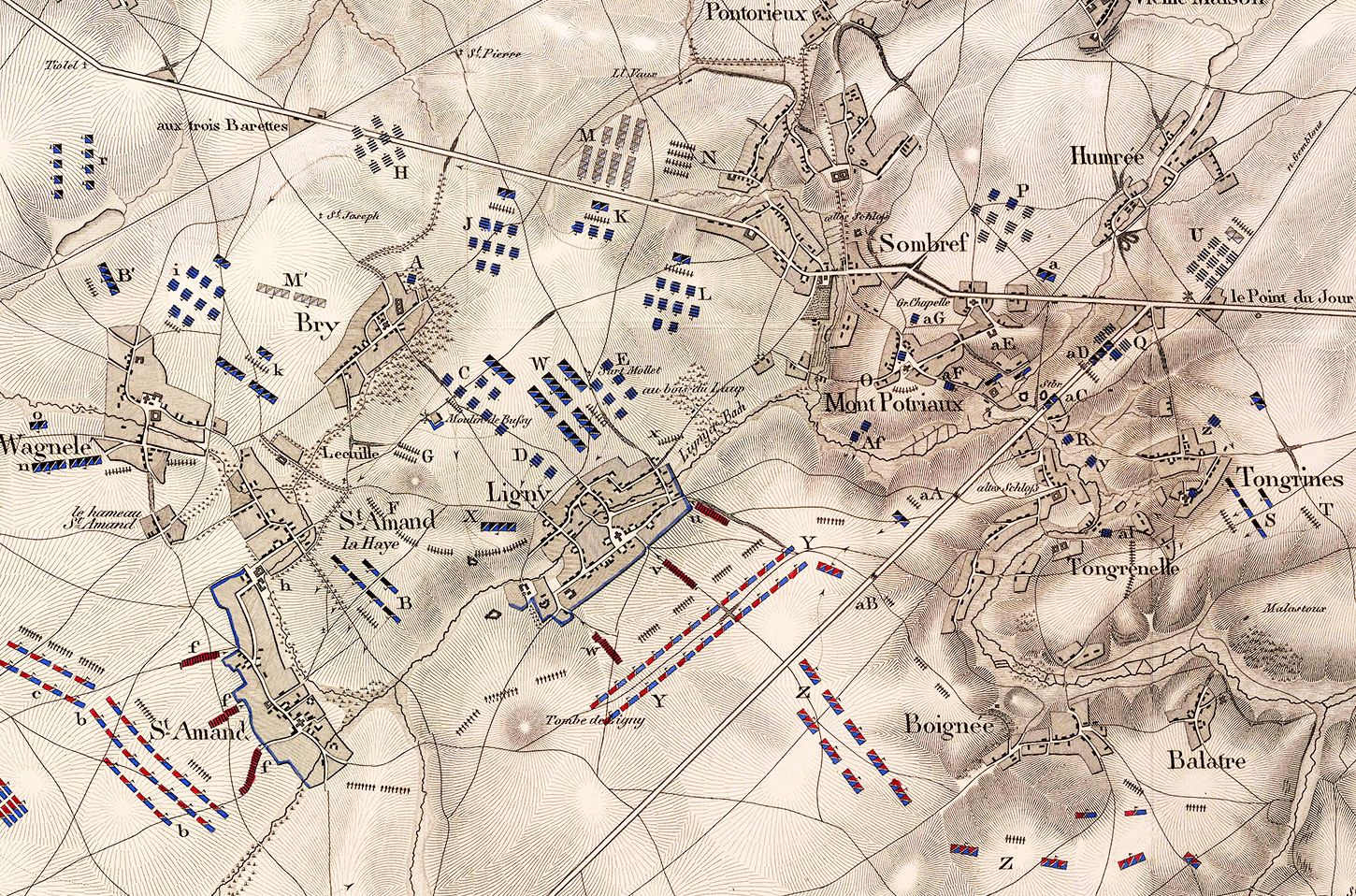
The essentials of the deployment were: Bry was occupied by three battalions of the 1st Brigade; Saint-Amand by three of the 3rd Brigade; and Ligny by four battalions of the 4th Brigade. The remaining six battalions of the 1st Brigade were at the front in two lines just behind Saint-Amand (B).[86] The eight battalions of the 2nd Brigade (one battalion having been lost), along with the remaining two battalions of the 4th, were in a second line between Bry and Ligny (C and D). Finally, the six remaining battalions of the 3rd Brigade were in a third line just behind the 2nd and 4th (E).
The 1st Corps’ reserve cavalry stood initially in front of the villages to observe the enemy, and afterwards placed itself as a reserve just in front of the 3rd Brigade (W).
The 2nd Corps stood along the Brussels road as the main reserve, the brigades next to each other (H, J, K, L,) in their prescribed order of battle of three lines in column. The reserve cavalry was behind (M). The artillery was for the most part still with the brigades: Just the three heavy batteries of the 1st Corps had been advanced between Ligny and Saint-Amand.
The intention was to fight only a preliminary action in the villages of Saint-Amand and Ligny, in order to disrupt the enemy's force, and then to fall upon it as soon as it advanced from the villages.
Chapter 28
Dispositions on the Front at Sombreffe
The 3rd Corps placed its 9th Brigade to defend the extended villages of Sombreffe and Mont-Potriaux, as well as the ridge on which they are located; the 11th Brigade to defend the highway from Point-du-Jour; the 10th to defend the ridge of Tongrines and Tongrinelle; with the 12th Brigade and the reserve cavalry behind them as a reserve. The 9th Brigade initially occupied only the village of Mont-Potriaux with one battalion, while the other eight battalions remained in reserve behind the village (P). The 11th Brigade occupied the valley [of Ligny Brook] with one battalion (R) and kept the other four in the rear (Q), one battalion having remained at the outposts on the Meuse.
The 10th Brigade occupied the valley with two battalions and placed the other four on the ridge.
The intention was to use the skirmish line to hold the enemy in the valley at all points for as long as possible, and then, when this line could no longer be held, to engage the enemy on the ridge with full battalions.
The artillery was distributed mainly on the heights in front of Mont-Potriaux, on the main road in front of Point-du-Jour, and on the heights at Tongrinelle.
Chapter 29
Arrival of the Duke of Wellington
These arrangements were carried out very calmly by noon, because—as had been foreseen—the enemy could not begin his attack before noon and did not in any way impede General Ziethen's withdrawal from Fleurus into this position.
At 1 p.m. the Duke of Wellington came to Marshal Blücher at the windmill of Bry. The duke told the field marshal that his army was at that moment assembling at Quatre-Bras, and that in a few hours he would hasten with it to assist Blücher. "At four o'clock I will be here," are supposed to have been the duke's words as he spurred his horse away.
It would have been unreasonable to suppose that the duke could arrive in a few hours with his whole army. Wellington must have meant nothing more than his left wing united with his reserve, which nonetheless amounted to 40,000 to 50,000 men. Both commanders thought that the whole French force (estimated at 130,000 men) was facing the Prussians. Blücher had assembled around 80,000 men, so if the duke came with another 40-50,000 there would have been a rough equality of forces. They were also counting on Bülow's arrival, although not without some uneasiness on that score. If his 35,000 men arrived, victory seemed pretty certain. Even though these ratios were not as advantageous as they might have been, given the Allies' great superiority of numbers, they still seemed satisfactory. A withdrawal in order to delay giving battle for a day seemed fraught with difficulties because of the two armies' diverging lines of retreat. Each army might have abandoned its natural line of communication for a short time and turned toward the base of the other, if they had been together. But they were not together, and a simultaneous march to the rear would actually have impeded their union. Furthermore, it would have made a bad impression on the troops and the public. All these reasons—which were indeed sufficient—confirmed Field Marshal Blücher’s resolution to stand and give battle. The battle was therefore undertaken in the belief that the Prussians would have to face a great superiority of numbers at first, but that by the end of the day the superiority would be on their side. It was only a matter of putting up sufficient resistance until then.
Chapter 30
Bonaparte's Plan of Attack
As we know, on the 15th Bonaparte had sent Ney forward on the road to Quatre-Bras with the 1st and 2nd Corps, the light cavalry of the Guard, and a division of cuirassiers, altogether 48,000 men. While this mass of troops was advancing from Marchiennes, where they had crossed the Sambre, Girard's division of the 2nd Corps was employed against General Steinmetz at Gosselies. Since it moved closer to the French center while pursuing him toward Heppignies, Bonaparte kept it with him. The main army advancing against Blücher now consisted of about 75,000 men. Bonaparte gave it the following dispositions and objectives:
The 3rd Corps (Vandamme), together with Girard's division and supported by a brigade of light cavalry of the Guard, 24,000 men in all, would advance via Wagnelée to attack Saint-Amand.
The 4th Corps (Gérard), 15,000 men strong, would turn to the left and advance to attack Ligny.
Grouchy would advance against Point-du-Jour and Tongrinelle with two corps of cavalry and some infantry (no one says from which corps but probably from the 4th).
The Guard was placed in reserve to the left of Fleurus. The 6th Corps (which arrived somewhat later) and Milhaut's cavalry corps were placed in reserve to the right.
These reserves and Grouchy's cavalry, which merely scouted, amounted to a force of about 36,000 men.
Bonaparte did not know the position of the Prussian 3rd Corps. He believed that all three Prussian corps were deployed between Saint-Amand and Sombreffe. He was all the more certain that what he saw in this position was the whole Prussian army because he saw numerous masses of reserves in locations H, I, K, L, and P. Assuming the villages were strongly held, these could easily have comprised the total of 80,000 men he had in front of him. Whether he knew for certain that the 4th Corps had not yet arrived cannot be determined. Later on, he claimed as much, in order to put his attack plan in a more favorable light. But it is scarcely possible that he could have been completely sure of this, since even the prisoners he had taken at the start of the battle could not have known for certain. We will therefore leave this question open and turn to his own description [in his Memoires].[87] There, he saw the Prussian army as being deployed along a line with the Brussels road behind it, which meant that the Prussians had completely abandoned their original line of retreat and had exposed their right flank to him.
In reality, the principal orientation of the Prussian position, even without considering Thielmann's [3rd ] Corps, was not as Bonaparte conceived it. On the contrary, the Brussels road was more parallel than perpendicular to it. But Bonaparte did not see things this way, and this mistake is quite understandable, because it was very difficult to form an idea of the orientation of the whole shape based on the many individual masses of the Prussian brigades. It was very natural to imagine that the line from Saint-Amand to Ligny, plus the line of the latter village itself, which were the most forward occupied posts, was the dominant line of the whole force. The Prussian deployment amazed Bonaparte and led him to conclude that Blücher was not expecting a battle on that day. Thus Blücher had chosen this position—astonishing under the circumstances—in the hope of gaining time until the next day, and of then seeing the English army take up its position in line with the Prussians. Bonaparte attributed the fact that Blücher continued to maintain this deployment while face-to-face with the French army partly to the old man’s audacity and desire to maintain an imposing countenance, and partly to the apparently unthreatening nature of Bonaparte’s own position near Fleurus, where a portion of his troops was completely concealed.
Bonaparte was now almost certain that Wellington could not arrive. On this point he was much more likely to have had definite news than about Bülow. Furthermore, he thought that he had taken care of [Wellington] by the orders he had given Ney. Everything thus depended on Ney, who, having missed his chance on the 15th, was supposed to press forward to Quatre-Bras as quickly as possible on the 16th , thereby holding off whatever aid might have come from Wellington. Ney was then to send 10,000 men back on the Quatre-Bras-Namur road into the rear of the Prussian army. In his enthusiasm for this plan, Bonaparte said to General Gérard, who had come to him for instructions: "It may be that in three hours the fate of the war will be decided. If Ney executes his orders properly, not a single cannon of the Prussian army will escape. They have been caught en flagrant délit."
Chapter 31
Critical Analysis
There is strong reason to doubt that Bonaparte's intentions were truly as he has stated at the time he gave his orders for the battle. In his narratives and dictations he has demonstrated all too often that he is not truthful and forthright. It may well be that in this case he also wished to appear to be less of a gambler, not just in his attack on Blücher but in his whole second appearance on the political stage. He was destroyed by the combined strength of Blücher and Wellington, but his vanity requires that this appear not to have resulted from the force of circumstances, but from mistakes by individuals. This brief for the defense, as the lawyers call it, therefore requires him to argue that the Prussian Army would already have been lost on the 16th, if Bonaparte's plans had been carried out.
No study to date has been able to show to what extent Marshal Ney actually acted contrary to Bonaparte's orders on the 16th, because Gamot's defense of the Marshal also does not clear this up completely.[88] However, it will definitely contribute to a better understanding of the matter if we present word-for-word the four orders that Marshall Ney received in the course of the 16th, according to Gamot's book.
First Order
Charleroi, 16 June 1815
Marshal! The Emperor has just ordered Count Valmy, commanding the 3rd Cavalry Corps, to concentrate and head for Gosselies, where he will be at your disposition.
His Majesty's intention is that the Guard Cavalry, which had been on the road to Brussels, remain behind and rejoin the remainder of the Imperial Guard; but in order that it should not have to make a retrograde movement, you can replace it in the line and leave it a little to the rear and he will send its orders for the day there. Lieutenant General Lefebre-Desnouettes will send an officer to pick up the necessary orders.
You will inform me whether the corps has carried out its movement and of the exact position this morning of the 1st and 2nd Corps and of the two cavalry divisions which are attached, informing me what enemy forces are in front of you and what has been learned.
Signed: Chief of Staff, the Duke of Dalmatia
Second Order
Charleroi, 16 June 1815
Marshal! An officer of lancers has just told the Emperor that the enemy has appeared in force near Quatre-Bras. Unite the corps of Counts Reille and d’Erlon and that of Count Valmy, who is just marching off to join you. With these forces you must engage and destroy all enemy forces that present themselves. Blücher was at Namur yesterday and it is unlikely that he has sent any troops toward Quatre-Bras. Thus you will only have to deal with the forces coming from Brussels.
Marshal Grouchy is going to move on Sombreffe as I informed you, and the Emperor is going to Fleurus. You should address future reports to His Majesty there.
Signed: Marshal of the Empire, Chief of Staff, the Duke of Dalmatia
Third Order
In front of Fleurus, 16 June, at two o'clock.
Marshal! The Emperor has directed me to warn you that the enemy has gathered a body[89] of troops between Sombreffe and Bry, and that at two-thirty Marshal Grouchy will attack it with the 3rd and 4th Corps. His Majesty’s intent is that you should attack all that is in front of you, and that, after having vigorously pushed it back, you should advance toward us to assist in enveloping the force I just mentioned. If this force has already been smashed, then His Majesty will maneuver toward you to speed up your operation in turn. Immediately inform the Emperor of your dispositions and of what is happening on your front.
Signed: Chief of Staff, Marshal of the Empire, Duke of Dalmatia
Fourth Order
In front of Fleurus, 16 June 1815, at three-fifteen
Marshal! I wrote to you an hour ago that the Emperor would attack the enemy at two-thirty in the position he has taken between Saint-Amand and Bry. At this moment the engagement is very fierce. His Majesty has directed me to tell you that you must maneuver onto the field in such a manner as to envelop the enemy right and to fall with full force on his rear. The enemy army will be lost if you act vigorously. The fate of France is in your hands. Therefore do not hesitate an instant to move as the Emperor has ordered, and head toward the heights of Bry and of Saint-Amand to co-operate in a victory that may be decisive. The enemy has been caught en flagrant délit while trying to unite with the English.
Signed: Chief of staff, the Duke of Dalmatia.
In contrast, Bonaparte wrote in his previously mentioned memoirs:
An officer from the staff of the left wing reported that, at the moment when Marshal Ney was marching into position in front of Quatre-Bras, he was stopped by the sound of cannon on his right flank, and by reports that the Anglo-Dutch and Prusso-Saxon armies had already linked up in the vicinity of Fleurus; that had he continued his movement under these circumstances he would have been outflanked; and that he was ready to execute any commands the Emperor should send him, once His Majesty became aware of this new development. The emperor blamed him for having lost eight hours already. What Ney claimed was a new development had in fact existed since the day before. The emperor reiterated to Ney the order to carry all before Quatre-Bras, and that as soon as he had taken the position he was to detach a column of eight thousand infantry, together with Lefebre-Desnouettes's cavalry division and twenty-eight guns, via the road through Marbais, in order to attack the rear of the enemy army on the heights of Bry . With this detachment gone, there would still remain to him thirty-two thousand men and 80 guns at Quatre-Bras, which will be sufficient to hold in check the detachments of the British army that might arrive on the 16th. Marshal Ney received this order at 11:30 a.m. He was near Frasne with his advance guard; he ought to have taken up his position in front on Quatre-Bras at mid-day. Now, from Quatre-Bras to the heights of Bry is eight thousand yards; the column that he detached against Marshal Blücher's rear should therefore have reached Marchais by two o'clock. The line that the French army occupied near Fleurus was not aggressive. Part of it was masked; the Prussian army should have had no cause for concern.[90]
Although it cannot be said that this narrative contradicts the four orders, the following must be noted:
1. A specific mission such as the one described [in the Memoirs] cannot be found among the orders to the Marshal. Perhaps it was verbal, perhaps it has been lost.
2. The third order does not make reference to any previous order along similar lines, but instead presents the situation differently; Soult would probably have been the one who wrote the order mentioned by Bonaparte, or at least would have had precise knowledge of it.
3. Anyone who has a little experience in these matters will find that the four orders reproduced by Gamot have a greater ring of truth than the account given by Bonaparte in his memoirs.
4. Finally, Bonaparte’s account lists the Guards Cavalry Division among the forces allocated to Marshall Ney, while the first of the three orders clearly calls for it to remain behind. On St. Helena Napoleon may have forgotten this situation, but not a few hours after he gave the order.
And now for the internal consistency of this disposition [as described].
1. Ney is to advance nine miles toward Brussels with around 40,000 men, where he is likely to encounter 50-60,000 English and Dutch troops. He is supposed to defeat them, and no doubts are raised about the likelihood of doing so, even though English troops led by Wellington had on many occasions defeated French marshals quite decisively.
2. Around midday the main body of Marshal Ney's force was still at Gosselies, three hours’ march from Quatre-Bras. This force must cover this distance, for even though Ney himself is with the advanced guard at Frasnes, that is not sufficient. Then he must begin and end a battle, and afterward march 10,000 men three hours toward Saint-Amand to help end another battle, which has been going on at the same time. If all this was not completely impossible, it was certainly not very realistic.
3. Why should the appearance of 10,000 men in the rear of the 80,000-man Prussian army, in open countryside with complete visibility all around, have necessarily caused it to collapse completely? By simply appearing on the field they might tip the scales in an undecided battle, and force Blücher to retreat earlier; but that is still a long way from collapse, i.e., complete destruction such as at Jena.[]
We must therefore conclude that this Bonapartist narrative, written in solitude on St. Helena, is a kind of bombast, and that at the moment of action Bonaparte's entire concept was simpler and more natural.
He saw the greater portion of Blücher's army in front of him, estimated it as smaller than it really was (because he thought the 3rd Corps arrived only during the course of the battle), and hoped in any case to defeat Blücher quickly. In the meantime Ney, with around 40,000 men, would be able to hold off the assistance being rushed over by Wellington, and to send any extra troops against Blücher's rear. This was more or less his plan. Just how big his victory over Blücher would be was something Bonaparte could not determine in advance, given his situation. He would have to be satisfied with whatever results a very forceful blow could bring. Time, forces, and circumstances were insufficient for an overwhelmingly destructive plan to be realized. If a moderate victory would not help him, if it did not pull him back from the abyss toward which he was tottering like a great daredevil, then it only shows how insecure his position was, how dangerous his game—and it is precisely about this that he wants no word to be said.
Chapter 32
Principle Moments of the Battle
There are three distinct but simultaneous acts to distinguish among in relating the course of the battle itself: the fighting around the village of Saint-Amand; the fighting around the village of Ligny ; and the demonstration against the 3rd Corps.
The first of the three acts was the bloodiest, the second the most decisive. The third was unimportant in itself but must be considered an effective feint by the French.
[1. The Fighting at Saint-Amand]
Events regarding the fight for the village of Saint-Amand can be grouped roughly as follows.
1. The southernmost village, that is Saint-Amand proper, was attacked at 3 p.m. by Lefol's division of the French 3rd Corps. The Prussian 1st Brigade, which had six battalions posted behind the village, supported the three battalions of the 3rd Brigade inside it, and maintained the action for an hour, during which the village changed hands several times and the three battalions that had stood in Bry were brought forward and used up. At 4 p.m. the village was lost and the 1st Brigade was no longer able to continue fighting; it was withdrawn and reformed behind Bry (g) [Map 2]. The advance of Girard's division into Saint-Amand-la-Haye presumably contributed to this success.
2. Field Marshal Blücher decided on a strong attack in two columns in order to retake the villages of [Saint-Amand and] Saint-Amand-la-Haye.
One column, consisting of the 2nd Brigade, which had stood in reserve near Bry with its eight battalions, was to attack the broad side of the latter village. Meanwhile, General Jürgass with the 5th Brigade and seventeen squadrons of cavalry—namely ten from his own brigade and seven from Marwitz's brigade brought over from the 3rd Corps—was to advance through and alongside of the village of Wagnelée so that he could attack the left flank of Girard's division defending Saint-Amand-la-Haye. In this manner the Prussians hoped to regain possession of this village and subsequently also Saint-Amand itself.
General Pirch [II] made two attacks. The first miscarried completely; the second, under Blücher’s personal leadership, went right into the village and resulted in the capture of the churchyard.
General Jürgass also made two attacks, but these do not appear to have been well coordinated with those of General Pirch [II]. In the first attack, the 25th Regiment, which was leading the advance out of Wagnalée, fell quickly into disorder, and the attack must be considered a total failure. General Jürgass then renewed it with the same troops after reforming them in the rear, and this time he was more successful; that is, he pressed forward into the area around the village of Saint-Amand-le-Hameau, and here the fighting ground to a halt for some time.
In response, Bonaparte reinforced his left wing with a division of the Young Guard and the French renewed their attacks. Because the 2nd Brigade was exhausted and had expended all its ammunition, four battalions of the 6th Brigade were brought forward from its position behind Bry and General Pirch moved the 2nd Brigade back behind that village. The 7th Brigade likewise advanced to reinforce the 5th. There is no precise account as to what took place on either side at this point. The fighting was probably confined to a rather small space, fluctuating back and forth. Both sides may have been in nearly the same situation, since each occupied a portion of the village of Saint-Amand-la-Haye. From what we can garner from the various accounts, it would appear that the battle always remained on the far side of the small brook where the villages of Saint-Amand are located.
Nothing clear and definite can be said about the effect and the employment of cavalry and artillery because the accounts of the use of these arms are too disjointed, perhaps because their employment was, too. Many units from these arms do not even appear in the accounts of this action. If we add together the reserve artillery of the 1st Corps as well as the batteries of the 1st, 2nd, 5th, and 7th Brigades, which were undoubtedly there, this makes ten batteries or 80 guns. There were probably several reserve batteries of the 2nd Corps also in action here as well, and taken all together this makes a total of 100 guns that were fighting in a space of around 3,000 paces.
The artillery of the French 3rd Corps consisted of 38 guns, that of Girard's division 8 guns. If we add to this around 30 guns belonging to the Guard and the reserve cavalry, the total number of French guns must have amounted to only 76. At any rate, the number was considerably smaller than that of the Prussians. If we are nevertheless obliged to agree that the Prussians lost more in killed and wounded, this is surely due to the fact that we hold too much artillery in reserve, and relieve a battery as soon as it has expended its ammunition. For this reason some gunners try to expend their ammunition as quickly as possible.
Cavalry seems to have been employed very little on either side and merely observed each other. Three French regiments attempted to turn the Prussian right wing but were checked by the eight squadrons sent against them by Colonel Marwitz.
3. Finally, we must consider as the third principal act in the fighting about Saint-Amand the time when Field Marshal Blücher, believing on account of the movement of the French Guard that the French army was retreating, led the last available battalions—three from the 8th Brigade—to Saint-Amand in order to break through the French there and then pursue them. This decision reveals that the fighting at Saint-Amand must have hung in the balance, for otherwise the thought of attempting a breakthrough and pursuit with fresh troops could never have arisen.
A summary of the results of this entire struggle shows that our side had gradually committed around 40 battalions, thus perhaps 28,000 infantrymen, while on the French side, the 3rd Corps, Girard's division of the 2nd Corps, and Duhesme's division of the Guard, altogether about 24,000 infantrymen, had been committed and had maintained the fight for six hours, for the Prussians retained possession of the villages until 9 o'clock. But on the whole we were somewhat at a disadvantage, since we had lost all of Saint-Amand and half of Saint-Amand-la-Haye, we had suffered more casualties in killed and wounded, and overall we had been weakened more, with more of our units burnt out and fewer that could still be employed compared to the French, for it is not likely that all of the French battalions had been involved in the actual fighting. It was therefore a setback for us that we had already suffered noticeably more in this fight than the enemy. However, this success was clearly not decisive, but rather an almost imperceptible tipping of the scales.
[2. The Fighting at Ligny]
We now turn to Ligny. Here the action was even simpler than at Saint-Amand. It consisted of a five-hour-long firefight, principally in the village itself, during which the French were generally in possession of the half of the village lying on the right bank of the brook, while the Prussians had the other half.
The attack on Ligny was carried out by the French 4th Corps under Gérard, and the decisive stroke was made by the Guard itself under Bonaparte. It began somewhat later than the attack on Saint-Amand. The following events can be considered the most important ones:
1. Ligny was occupied by four battalions of the [Prussian] 4th Brigade. The attack advanced in three columns, consisting of the three divisions that made up the [French 4th] Corps, though we must assume that the greater part of these divisions was held back in reserve. The two remaining battalions of the 4th Brigade also moved into the village, and the first attack was repulsed.
2. The French renewed the attack, the 4th Brigade gradually became too weak to resist, and the 3rd Brigade, after leaving two battalions to protect the artillery batteries, moved four battalions into the village for support. General von Jagow wanted to advance with them out of the village and go over to the attack, but the fire of the enemy batteries made it impossible to break out. This led to disorder among the troops in the village itself, which is probably why half of it was lost.
3. So as not to lose the other half, the remaining four battalions of the 6th Brigade were ordered to Ligny. (One battalion had already been used up in Ligny, and four others had been employed by General Pirch in the attack on Saint-Amand.) These were later followed by five battalions of the 8th Brigade, which had previously moved from the area around Sombreffe to the mill of Bussy. Of the remaining four battalions of this brigade, one stayed at the mill and the other three were those that Field Marshal Blücher led into Saint-Amand. With respect to the use of cavalry and artillery, we know even less than we do concerning Saint-Amand. Assuming that the Prussian artillery at Saint-Amand consisted of 100 guns, then there could not been more than 60 at Ligny, for the whole complement of artillery for both corps was only 160 guns.
The French 4th Corps had forty cannon, but it is likely that part of the Guard’s artillery, as well as that of the cavalry reserve, was employed here, so at this place it is unlikely that our side had any superiority in artillery.
The Prussian cavalry had for the most part been drawn away to the right wing, for when the French cavalry broke through later on only three [of our] regiments were found here.
The contest in Ligny now continued in a very confined space and with the most bloody exertions. The mass of Prussian infantry employed there amounted to 20 battalions, thus about 14,000 men. The French 3rd Corps may have been equally strong in infantry.
At about 3 p.m. Field Marshal Blücher ordered General Thielmann to send a brigade of his reserve cavalry. This was done, and Colonel Marwitz was placed under the command of General Jürgass, as we mentioned in describing the action near Saint-Amand. Around four o'clock, General Thielmann received orders to send a brigade of infantry, too, whereupon the 12th Brigade marched off to Ligny. It was placed in reserve between Sombreffe and Ligny in place of the 8th. The 12th Brigade pushed its skirmishers forward as far as Ligny Brook and covered the left flank of the troops in Ligny in an engagement that was not without importance. The brigade did not suffer very heavy losses, however, and thus could still be considered a reserve.
Bonaparte resolved to break through the position at Ligny with the main body of his Guard and thereby force a decision in the battle. This thrust occurred at about 8 p.m. and was the final phase of the action at Ligny.
4. Eight battalions of the French Guard and 3-4,000 cavalry advanced for the decisive blow against Ligny, and drove the Prussian troops out of the whole place. The French cavalry pushed through the center of the Prussian position, which was nearly devoid of infantry. The reserve cavalry of the 1st Corps rushed over by brigades to counterattack the enemy's cavalry and infantry, but was repulsed at all points. Field Marshal Blücher’s horse was wounded while he was leading one of these counterattacks, and he escaped capture only by chance.
3. The Action of the Prussian 3rd Corps
Two corps of cavalry and some infantry, probably from the 4th Corps under Grouchy's command, were employed to demonstrate against the Prussian troops between Sombreffe and Saint-Balâtre and thus keep them occupied. This goal was accomplished, because the 10th and 11th Brigades (with eleven battalions) and the 2nd Brigade of the reserve cavalry (with six squadrons) were thereby fixed in place. On the other hand, the 12th Brigade and one brigade of the reserve cavalry moved over to the other two corps, and the 9th Brigade, posted behind Sombreffe, can be considered as a reserve. The infantry action was unimportant in itself, and took place almost entirely on the terrain occupied by the 10th Brigade between Tongrinelle and Boignée.
Between 7 and 8 p.m. General Thielmann saw the skirmishers of his 12th Brigade, which was between Sombreffe and Ligny, crossing the stream. He saw also that the cavalry opposing him was dwindling down to few troops. He therefore believed that the enemy was retiring, and decided to advance across the defile with his remaining brigade of cavalry. Two squadrons were sent forward, and a battery of horse artillery imprudently followed close behind. Scarcely had these units approached the nearby heights when some enemy regiments threw themselves on the two squadrons and took five guns from the horse artillery battery, which had attempted to unlimber its guns instead of turning back. The remaining three guns had time to save themselves.
To summarize our impression of the battle as a whole, it is—like all recent battles—a slow consumption of the forces opposed to each other in the front line, where they engage in a firefight of many hours' duration with very little fluctuation, until at last one side acquires a noticeable superiority in reserves, that is, in fresh masses of troops, with which it then gives the decisive blow to the already shaky enemy force.
Bonaparte advanced with about 75,000 men against Blücher, whose three assembled corps together made a force of 78,000 men, thus a force of comparable strength.
Bonaparte used about 30,000 men to engage the two principal points of Blücher's position, Saint-Amand and Ligny, from 3 p.m. to 8 p.m. He employed around 6,000 men to occupy the Prussian 3rd Corps, and kept 33,000 waiting calmly in reserve, far behind the battle line. Of these he used about 6,000 to maintain the struggle at Saint-Amand.
He decided as early as 6 p.m. to deliver the decisive blow on Ligny with his Guard, but then he suddenly received reports that a sizeable force had appeared an hour's march from his left flank. Bonaparte halted his movement, as this could be an enemy force coming from Brussels. In fact it was d’Erlon who, acting on orders the source of which is still not known, was marching from Frasnes towards Saint-Amand. Scouts were hastily sent to reconnoiter this force, but nearly two hours elapsed before the news was brought back that this was the French 1st Corps. It is for this reason that the thrust against Ligny did not begin until 8 p.m.
Bonaparte did not even deliver this blow with the whole mass of his reserves, but only with about half of it (that is, with the remainder of the Guard), while the 6th Corps remained behind, still in reserve.
At the beginning of the battle, Blücher had the 1st Corps (27,000 men) in Ligny and Saint-Amand, and the 3rd Corps (22,000 men) deployed from Sombreffe to Saint-Balâtre. Only the 2nd Corps (29,000 men) was kept behind in reserve. While it is true that the 3rd Corps had not been seriously attacked, and thus could have been concentrated and used as a reserve, and also that Blücher was counting on the arrival of Bülow, neither of these things occurred, so the ratio of Prussian reserves to those of the French always remained unfavorable. As we have seen, 2nd Corps, the actual reserve, was gradually used up in maintaining the action. Therefore nothing remained with which to deliver a decisive blow if the battle had remained wholly in the balance, or had even taken a turn in our favor.
As the end of the day approached, the situation of the opposing forces was approximately as follows.
Blücher had committed 38,000 infantry to the two villages. They had suffered substantial losses and in some cases had used up their ammunition and now had to be considered mere cinders, in which little living energy remained. There were still 6,000 infantry standing behind the villages, scattered in solitary battalions that had not yet been engaged. The remaining 56,000 men in the 1st and 2nd Corps were cavalry and artillery, of whom only a small portion were still fresh.
If the 3rd Corps had been concentrated, or if appropriate steps to do so had been taken in time, it could have constituted a reserve of 18,000 men. One could therefore say that at the decisive moment Blücher still had a reserve of around 24,000 men.
Although originally a few thousand men weaker than Blücher, Bonaparte now had several thousand more fresh troops than his opponent. The reason for this was his greater restraint, his greater economy of force during the firefight.
This small superiority of numbers in the French reserve naturally would not in itself have been very decisive, but it still must be considered as the first reason for the victory.
The second was the unequal results obtained in the firefight thus far. To be sure, when Bonaparte made his advance against Ligny we still held part of that village, but we had nonetheless lost the rest. Likewise we still held on between Wagnelée and Saint-Amand, but here too we had lost villages and terrain. Thus the battle had already turned a little to our disadvantage everywhere, and in such cases the stage is prepared in advance for the decisive blow.
But the third and most important reason for the outcome was indisputably that Blücher did not have close at hand the troops who had not yet been engaged, namely the 3rd Corps. To be sure, the 12th Brigade was near by, but this was too little. The 9th was also not far away, but insufficient attention had been paid to it, and to the whole of Thielmann's corps. For this reason the 3rd Corps might as well not have been there at all as far as the decisive moment was concerned. It could only be useful in the retreat. Nevertheless, we may possibly (even probably) consider the scattered disposition of Thielmann's corps to be an advantage overall. If the 3rd Corps had been at hand, it would have been used up in the same manner as the rest, without increasing the prospects for success. Given the turn of events that had already occurred, a successful outcome [for the Prussians] could only have been obtained by a decisive superiority in numbers, as would have occurred with the arrival of Bülow's corps. Had the 3rd Corps been consumed along with the others, our losses in the battle might well have been 10,000 more.
Chapter 33
Critical Remarks on the Whole Battle: Blücher
1. Blücher's main mistake appears to have been a certain lack of clarity in his plans, which resulted in the occupation of two fronts and the neutralization of 20,000 men. The position from Sombreffe to Saint-Balâtre was good if the intention was to preserve the line of retreat towards the Meuse. In that case, however, it would have been necessary to remain along that front and to view the connection with Wellington as solely a matter of fighting a common enemy, not one requiring direct union. In such open countryside it would be easy to see if Wellington was advancing on the road from Quatre-Bras, so direct union was so unnecessary as to be a disadvantage. [As it was,] Wellington’s natural line was like that of a corps sent against the enemy's flank, a form of attack that is always sought with the greatest care, and which is warrranted as the most decisive form whenever one is stronger and has the broader base.
If, however, it was intended in the worst case to give up the line of retreat to the Meuse, then the position at Sombreffe was quite unnecessary. It should have been held by a single brigade at most, in order to keep the enemy hemmed in. It was not necessary to occupy this position in preparation for the Bülow’s arrival. Just as with the preceding example of Wellington, 35,000 men operating as a flanking force would have been able to cross Ligny Brook even if the enemy had held [Sombreffe], which was not all that likely.
In preparing so great an action as a battle, nothing seems more essential than to to have a clear idea of the general relationships involved. Of these, none is as important or influential as the roads to be used for a retreat, for these determine the position of the front and all the key lines of possible movement during the battle. In this case Blücher remained stuck in half measures, that is to say, caught between two contradictory ones.
2. Even during the course of the battle, i.e., between about 4 and 5 p.m., orders might have been given to General Thielmann to assemble his corps and to advance from Mont-Potriaux and Point-du-Jour against the enemy right flank. In that case, Gérard's corps would either have had to give way or would have required earlier support from the Guard. Even if General Thielmann had then been attacked by Grouchy and the Guard, and forced to retire back over the brook, the French reserve would still have been absorbed earlier, and the blow against the center at Ligny would probably not have taken place at all. In that case, the battle would probably not have been decided on the evening of the 16th. In any event, it would have weakened the French army much more.
3. With respect to defending the villages, the defense of Saint-Amand proper appears to have been a damaging diversion from the main effort. If Saint-Amand was supposed to be an advanced post, then it must be said that such posts can be justified only on two accounts:
a. If they are inherently very strong, so that they force the attacker to commit disproportionate forces against them because he cannot bypass them; to which must be added that apart from their inherent strength, such posts must also be more or less supported by the front line of the army. If these advantages are not present, such a post will fall to an enemy attack from all sides. It is soon lost, and if you attempt to regain it, you often get involved in unplanned and disadvantageous engagements.
b. Occasionally one is forced to occupy a point that is in front of the line because it would give too much protection to the attacker in his approach. In that case it is a necessary evil.
Saint-Amand proper had no great inherent strength, it could receive almost no support from the front line of the army, and it did not even command this front sufficiently to prevent an attack on Ligny, for instance. Thus there was clearly no reason to occupy the village in accordance with the first consideration. Under the second consideration, it could be linked to the village of Saint-Amand-la-Haye, whose defense became tougher. But Saint-Amand’s connection with this village was only at its narrowest end, in the vicinity of the castle, where this castle offered the means to cut the line of defense. With respect to the front between Ligny and la Haye, Saint-Amand did not represent a threat. On the contrary, its location strengthened this front, because if the French had attacked us from there they would have had to deploy at a distance of 800 paces under the fire of our canister rounds. As a matter of fact, the French never advanced from it against the heights. The defense of this village consumed a whole brigade and probably caused no corresponding losses for the French. Its loss produced the adverse impression that we had lost a portion of our terrain.
4. The premature attack against Saint-Amand-le-Hameau and the attempt to mount another one from Ligny were likewise out of harmony with the whole scheme of battle. The defender must naturally incorporate into his defense a certain offensive principle; he must combine resistance with counterattacks. But such a counterattack must take place only when and where it can be done advantageously, i.e., if the enemy’s advance has placed him in the midst of our forces or if he has become severely weakened and can barely maintain himself, as a rule, therefore, only after his forces have exhausted themselves against our resistance. General Jürgass’ attack at Wagnelée against Saint-Amand-le-Hameau obviously came much too early to produce any decisive result at that point. If this general advanced up to the heights of la Haye, as he in fact did, he still had to stop there, and then found himself in a very unfavorable defensive position. But one does not choose the defensive in order to fight under unfavorable conditions. If Wagnelée had been occupied from the very beginning, and strongly provisioned with artillery, the enemy certainly could never have occupied la Haye. Wagnelée would have been a very decisive point, and because of its quite rearward position would have been very troubling to the French commander. But even after la Haye was occupied by the French, it seems that we would have done better to be content with occupying Wagnelée and thus holding the occupiers of la Haye in check. As long as Wagnelée, Bry, and Ligny were in our hands, the enemy could not possibly break out of either of the two villages of Saint-Amand. The whole position seemed instead to be well suited to gain time and inflict terrible losses on the enemy. The moment to break out of Wagnelée would have come only if we could have contemplated achieving a decisive success for the entire battle, in which case the advance should have taken place in greater strength. If, however, the situation was such that a counterattack could not be expected to result in a transformation of the whole battle, then it should have been omitted altogether, for the forces would have been far better employed simply by remaining on the defensive.
General Jagow's attempt to advance out of Ligny is even less justifiable. Even the most favorable outcome of this attack would still have left General Jagow out in the open in the midst of the French divisions, thus in a position that he could not have maintained and where he would have suffered heavy losses.
Our generals are too taken with the idea that it is better to advance than to stand and fire. Each of these actions has its proper place.
5. We consume our troops too quickly in a standing fight. Our officers call for assistance too soon, and it is given them too easily. As a consequence we commit more men than the French without gaining any ground—thus we have more killed and wounded—and we thereby transform fresh masses of troops into burnt-out cinders sooner.
We need not point out here that, with battle plans and all sorts of retrospective accounts in front of us, and with the events behind us, it is very easy to discover the actual causes of failure and, after thoroughly considering all the complexities of events, to highlight those things that can be deemed mistakes. But all of this cannot be done so easily at the time of action. The conduct of war is like movement in a resistant medium, in which uncommon qualities are required to achieve even mediocre results.[92] It is for this reason that in war, more than in any other area, critical analysis exists only to discover the truth, not to sit in judgment.
In considering the above-mentioned mistakes, we must also take into account that the Prussian troops consisted mostly of Landwehr who were only in their second campaign; that among them were many new formations from provinces that had never before belonged to the Prussian state, or at least not recently; that the French army, although also newly formed, still consisted of elements that had belonged to the best army in the world; and that Bonaparte was the greatest commander of his time. Under the circumstances, the overall results of Ligny cannot appear out of the ordinary. It is a battle which 78,000 men lost to 75,000 by a very slight tipping of the scales, after a long struggle, and without any truly glorious results for the victor, since his trophies consisted of only 21 guns and perhaps a few thousand prisoners.
Chapter 34
Bonaparte
1. The simplest way for us to describe Bonaparte's original plan of attack is that, as we have already said, he advanced against Blücher with two thirds of his army (75,000 men) and that he sent one third (some 40,000 men) against Wellington to stop whatever aid might be rushed from there to the Prussian commander. Bonaparte must have calculated that Wellington's force was not a whole army, and that 40,000 men led by a man like Ney would buy him enough time to complete his victory over Blücher. The thought that Ney could participate in [the battle with Blücher] could not yet have occurred to Bonaparte on the 15th or early on the morning of the 16th in Charleroi, because it was based on Blücher's position, which surprised Bonaparte, and seems to have given him the idea, that if Ney sent a detachment back along the road from Quatre-Bras to Namur, this would make the battle at Ligny much more decisive. This idea is first expressed in the third of the orders we have presented earlier.[93] But since the order seems to make cooperation only a secondary consideration—and in the nature of things it could not be anything else, because Bonaparte could not know whether Ney would have a single man to spare; and since the order was written at 2:15, which made it very uncertain whether there would even be time for Ney to do his part, given the three hours' march separating the battlefields—it is impossible to believe that such cooperation was in any way an essential element of Bonaparte's plan. Nor can we believe—as Bonaparte wishes us to—that it was merely an unfortunate accident, a mutilation of his original plan, that the Prussian army was not attacked simultaneously from the front and the rear, which according to Bonaparte would have brought about its complete and unavoidable destruction.
2. Furthermore, the fact that Bonaparte did not try to turn the exposed Prussian right flank and send a column via Wagnelée, but instead preferred to advance on Ligny with the second column—in fact even made his main thrust in this direction—means that we cannot consider his plan to have been based upon the idea of an attack by Ney into the rear of the Prussians, with Ney joining in to cause the destruction of the Prussian army. Rather, the direction of Bonaparte's main thrust was determined by the following factors:
a. As Bonaparte saw the Prussian position, the Prussian army’s right flank was at Saint-Amand proper, its center at Ligny, and its left wing at Sombreffe. Saint-Amand-la-Haye appeared to lie to the rear of the right wing. He therefore believed that if he attacked Saint-Amand and had a division march on Saint-Amand-la-Haye, this would already constitute an envelopment of the right wing. He wished to combine this with the attack on the center so that the battle would not be fought in too confined a space, which would have strengthened and prolonged the Prussian resistance. This therefore seems like a very simple and commonplace plan.
b. The attack on Ligny would certainly threaten the Prussian right wing, so one could expect that resistance there would be shaken by it. It was also very possible that part of the right wing would be completely lost as a result.
c. The attack on Ligny threatened the natural line of retreat of the Prussian army, and if they were determined to retain this at all costs, they would suffer heavy losses.
d. Finally, Saint-Amand and Ligny were the nearest possible points of attack for the front line of the French army at Fleurus. A wider envelopment via Wagnelée would have delayed the attack by as much as an hour, but it was already past noon when Bonaparte reconnoitered the Prussian position, so there was not much time to lose.
Thus the reasons for this form of attack seem to be sufficiently motivated by the immediate circumstances, and in war such immediate circumstances have the greatest weight in decision-making.
3. However, if we look at the matter from a more comprehensive point of view, we must first ask ourselves whether it was better for Bonaparte to attack Blücher in such a way as to drive him towards Wellington, or away from him. And we must of course reply that the latter approach would have had a much more decisive impact on the whole campaign.
If Bonaparte had attacked Saint-Amand with his right wing, Wagnelée with his left, and advanced with a third column toward the Brussels highway, then in the event of a defeat the Prussian army would have been obliged to retreat along the Roman road, that is, towards the Meuse. Union with Wellington during the next few days would then have been very uncertain, perhaps impossible.
4. If Bülow had arrived that afternoon, which was possible, and then been employed with Thielmann in an attack from Point-du-Jour, Bonaparte would have been obliged to fight a superior enemy force under the worst possible circumstances, namely with both flanks turned, on the left from Wagnelée, on the right from Point-du-Jour. Since Bülow was expected to come from Liége through Point-du-Jour, this could have been yet another reason for Bonaparte to turn the right flank of the Prussian army.
We do not know whether Bonaparte considered these matters or not, or whether his thinking may also have been influenced by concern that he was not safe from the direction of Brussels despite having detached Ney. If the latter supposition is true, then the form of his attack is sufficiently justified. But if he had no such concerns, and organized his attack solely on the basis of the immediate circumstances, one could certainly say that this plan was not entirely worthy of him and also not adequate to his precarious situation.
5. We are completely in the dark about the reasons for the movements of the French 1st Corps. Gamot, Ney’s defender, is convinced that Bonaparte himself pulled it over from Frasnes but is unable to produce any proof of this.[94] Bonaparte believes that Ney left the corps behind out of indecisiveness in order to cover his line of communications.[95] It seems almost impossible that Bonaparte could have called for it himself, for in that case how could its appearance have created his fear that the force was English; how could d’Erlon have turned around again; and how would it have been possible that the dispositions and orders given to Vandamme make no mention of this corps? One could well ask, however, why Bonaparte, after finding this corps in his vicinity, did not use it to envelop Blücher? In all probability because it was too late. He seems to have received the news of the appearance of this corps only at half past five. It was seven p.m. before news was brought him that it was d’Erlon, and an hour would have been required for d’Erlon to receive the order and perhaps another hour before he could show up in the area around Bry.
But all this is only an attempt to explain the matter, and there is no denying that the meager information that exists concerning the movements of this corps gives rise to suspicions against Bonaparte. Gamot names Colonel Laurent as the man who brought the order.[96] Why does this individual not come forward with an explanation? It cannot be out of regard for Ney's memory, for even if Colonel Laurent were to declare that he had carried no order from Bonaparte changing the employment of the 1st Corps, this would not result in much blame being placed on Ney. There is simply no other way to explain this obscurity than to suppose that loyalty and respect for the former emperor have closed the mouth that could speak.
In any event, this useless movement to and fro of 20,000 men, at a time when forces were needed so desperately, is a cardinal error that must always be blamed at least in part upon Bonaparte, even if he had not himself recalled the corps, because in that case the orders given to Marshal Ney must not have been sufficiently clear and precise.
Given all this, it can already be said that even on the 16th Bonaparte was no longer equal to the task that fate had imposed upon him.
Chapter 35
The Action at Quatre-Bras
We have already seen how Ney's troops were situated on the morning of the 16th. Ney left his 2nd Corps near Gosselies and instructed General Reille to wait for Bonaparte's orders. He himself hurried to his advanced guard at Frasnes and reconnoitered the enemy, which during the entire morning consisted solely of the greater part of Perponcher's division and two regiments of cavalry, thus around 6-8,000 men.
At eleven o'clock, General Flahaut, Bonaparte's adjutant, came to Gosselies with the order that Ney should advance and attack with his corps. This is probably the order to which Bonaparte was refers and which he says was in Ney's hands at 11:30 a.m. By the time the 3rd Division of the 2nd Corps reached Frasnes it was 1 p.m..
At this time, then, Ney was at Frasnes with 3 infantry divisions (of the 2nd Corps) and 3 cavalry divisions (Kellerman and the cavalry of the 2nd Corps), a total of about 23,000 men and 48 guns. He had left the light cavalry of the Guard behind Frasnes, as Bonaparte had specifically ordered this, and the 1st Corps was still on the march.
On the Allied side, Perponcher's division still found itself opposing him alone. At this time the Duke of Wellington was meeting with Blücher. It was only then that he became convinced that the main enemy force stood opposed to Blücher, and it seems that only then did he send the order to the divisions of his reserve, which had been standing at the exit of the Soignies Forest since 10 a.m., to start their movement toward Quatre-Bras. This explains why the first of these divisions—namely Picton's—did not arrive before 5 p.m. It is over 13 miles from Bry to and from there to Quatre-Bras more than nine miles.
The battle itself began at 3 p.m. and can be divided into three main phases.
In the first, Perponcher's division was driven from the terrain it had occupied halfway between Quatre-Bras and Frasnes. It lost four guns in the process and retreated in part into the woods of Bossu.
In the second, Picton's division—which arrived around 5 p.m.—restored the situation, took up a position along the Namur highway, and recaptured the village of Pierremont on its left flank. The Brunswickers arrived a little later and advanced on the road toward Charleroi, where they occupied the sheep farm. Now both sides were nearly balanced, for Wellington was also around 20,000 men strong, but Wellington only had about 1,800 cavalry while Ney had around 4,000.
The fight remained evenly balanced for a few hours. The French retook the village of Pierremont and maintained their hold on the Gemioncourt farm, next to the highway. Ney received Bonaparte's subsequent, urgent order to advance, overwhelm his opponent, and then participate in the Battle of Ligny. Indeed, Ney brought his reserve—Jerome's division—into action and made the utmost efforts with his superior cavalry forces to push through to Quatre-Bras along the highway. It was probably around this time that he sent the order to d’Erlon to rush over to him. Upon receiving it around 8 p.m., D’Erlon turned back in the vicinity of Villers-Perwin. The French cavalry's efforts resulted in their taking 6 or 8 guns, overrunning a few battalions, and penetrating partly into Picton's second line, but this did not lead to overall success. Both Piré and Kellerman were repeatedly forced to retreat when fire poured upon them from all sides. Nevertheless, in general the French seemed to gain the advantage in this fight, and they continued to advance farther into the Bossu woods.
Third Phase. Cook's and Alten's divisions, which constituted the right wing of the Prince of Orange's corps, arrived between 7 and 8 p.m. Cook's division was employed on the right wing in the Bossu Wood, Alten's division on the left wing against the village of Pierremont. Both overpowered the enemy and thereby caused a general turn of fortune in the battle. The resistance of the French remained very obstinate, however, and it was not until 10 p.m. that the allies became masters of the farm of Gemioncourt. Ney retreated to the area in front of Frasnes, where he took up a position. The losses were pretty nearly equal and were estimated at 4-5,000 men on each side.
Chapter 36
Reflections
Bonaparte and all the critics after him have raised a great clamor that Ney was negligent in failing to seize the position at Quatre-Bras before a substantial English force arrived, just as if Quatre-Bras were a fortress whose capture would have completely accomplished the objective of the operation. The expression "position" here is like one of those terms which, if used blindly like an algebraic formula, leads to hollow phrases and empty assertions.
Ney had been ordered to stop everything that Wellington could send to aid the Prussians. He could accomplish this either by defeating the force sent with this purpose, or by simply blocking its advance. The former required superiority in numbers, the latter a good position.
As for the force that Ney could expect to encounter, it was difficult for him to estimate its size because it consisted not only of what could be assembled against him in the course of the 16th, but also what might be there by noon on the 17th. We have seen that this could have been nearly the whole Anglo—Dutch army, or at least 80,000 men of it. Initially, as Ney could have foreseen, he encountered very few enemy troops at Frasnes and Quatre-Bras, or at least far fewer troops than he had himself. If he had defeated this handful, it would have been a small advantage, but would it also have been such an effective opening that he could view it as a virtual guarantee of complete victory? Impossible! Granted, he could have defeated the part of Perponcher's division that stood before him on the evening of the 15th or early on the morning of the 16th, and then taken up the pursuit. But in that case a commander like Wellington would have adjusted his actions accordingly, and chosen a position for the first reserves farther back, so that they could receive the defeated division, and then stand fast to gain time for the other divisions and corps to assemble. The farther Ney advanced, the more he hastened the moment when Wellington would be concentrated. Thus no matter how bold and fortunate Ney might be, the result would always be a great inequality of forces and a very dangerous situation. To reach any other conclusion, we would have to assume that the Duke of Wellington’s army would have been literally shattered by Ney, thrown into complete confusion, with individual divisions wiped out and so on. Such a supposition would be completely illusory.
Now one could well say that, even if Ney had encountered a far superior enemy on the evening of the 16th or the morning of the 17th, he would still have fully accomplished his objective by preventing this enemy from taking part at Ligny; and that the marshal could then have pulled back. But could Ney know for sure that no such overwhelming force was already facing him at midday on the 16th? Could he be certain—having been ordered to advance head down along a single road—that when he finally looked up he would not find himself surrounded and trapped by enemy columns on the right and especially the left? Would he not recall the fate of Vandamme in 1813?[97] What military commander has ever been required to advance 40,000 men up a single road between two enemy forces?
Based on these reflections, we see that Ney could never have thought that his offensive would rout the enemy forces coming toward him, but rather that his objective could be nothing more than to gain possession of Quatre-Bras and drive back whatever might already be there. This was all that Bonaparte had asked of him. One is therefore led to regard Quatre-Bras as a very good position, by means of which the marshal was able to hold off a superior enemy force throughout the 16th.
But is Quatre-Bras such a position? When the expression "position" is used, this seems to be assumed. But such a supposition is quite arbitrary, for no one has proved it [in this case], no one has ever suggested it, indeed no one has even spoken of it. Such an unfounded supposition can have no place in critical analysis.
In order to judge the value of Quatre-Bras as a position for Ney, one must have been there, for positions cannot be judged by maps alone and we do not even have a good map of this place. In general, however, we must say that such crossroads are disadvantageous as a position, because it is not possible to have a line of retreat perpendicular to the front. But even supposing that Quatre-Bras was a very good position, it certainly was never a strong one, and as Ney had no time to establish himself in it, he could not expect to gain much advantage from it in attempting to hold off a far superior enemy force.
Bonaparte had ordered Marshal Ney to Quatre-Bras because the two main roads met there, and therefore the road from Brussels to Namur —that is, from Wellington to the Prussians—would be cut. Nothing was more natural than these orders, and if Marshal Ney could have carried them out without danger, he would have been wrong to have failed to do so. But since Ney's appearance near Frasnes prevented Wellington from going to the assistance of the Prussians via the Namur highway in any case, Ney's failure to capture the crossroads was of no consequence. Indeed, in view of the reflections we have made here, one could go so far as to say that, no matter what Ney had done on the evening of the 15th or the morning of the 16th, the events brought about by or because of him either could not have occurred much differently than they did, or would have turned out much worse for the French.
Ney completely accomplished his objective of preventing Wellington from providing assistance [to Blücher]. The idea that Ney could contribute to the battle of Ligny only occurred to Bonaparte much later, namely after he had reconnoitered Blücher's position, and when he had not yet heard from Ney about a considerable enemy force. But by then it was too late to do anything. If Bonaparte had had this idea on the evening of the 15th, it would have been foolish to have made Ney's force so strong. Instead Bonaparte should have sent a corps down the Roman road to attack Blücher in the rear. Making Ney strong at first and then weakening him later was the opposite of what was required, for at the beginning he could just as well have been weak, but with every hour that passed the number of enemy troops opposing him increased.
The whole outcry against Ney is only an attempt by Bonaparte to make his plans appear more brilliant and splendid than they really were at the time of execution. His intentions were far simpler and more commonplace, and it was impossible for the marshal to have acted on a concept that was only developed after the events.
Admittedly, Ney could easily have driven Perponcher back early in the morning and stood at Quatre-Bras; admittedly he could even have sent an entire corps against the Prussian right flank via the Namur highway, without having the events at Quatre-Bras turn out much worse for him. But it is only now that we can all see that he could have done this, after considering all of the random circumstances that could not have been foreseen back then.
Chapter 37
Movements on the 17th of June: Blücher
The retreat of the Prussian 1st and 2nd Corps through Tilly toward Wavre took place partly on the night of the 16th and partly on the morning of the 17th. That of the 3rd Corps, which did not begin until around four or five in the morning, was directed toward Gembloux and from there to Wavre.
The 1st and 2nd Corps reached Wavre at midday on the 17th and then took their positions on both sides of the Dyle, having left part of their cavalry as a rear guard a few hours’ march behind them. The 3rd Corps remained at Gembloux until 2 p.m. and then proceeded towards Wavre, where it did not arrive until evening. The 4th Corps spent the night of the 16th in Haute- and Bas-Bodecé, two hours’ march behind Gembloux, and then during the 17th went to Dion-le-Mont, where it deployed to receive the other corps.
While the Prussian corps were carrying out the better part of these movements (that is to say, until noon of the 17th), the French were doing very little in the way of a pursuit.
During the night of the 16th, Bonaparte ordered General Pajol to conduct the initial pursuit of Blücher, using his cavalry corps and Teste's division from the 6th Corps. This general set out on the morning of the 17th and sought the Prussians first on the road to Namur. It is impossible to understand how the French failed to see that the Prussian 3rd Corps had [in fact] taken the road to Gembloux, since it did not move off until broad daylight. Even more incomprehensible is the French belief that Blücher would move his entire army toward Namur. This impression may have been prompted to some extent by the actions of a Prussian battery from the 2nd Corps, which was just arriving from Namur when it learned that the battle was lost, and attempted to turn back, but was captured on the road. But the main source of this absurd idea was Grouchy, from whom Pajol had received his detailed instructions. Grouchy himself was also supposed to pursue the Prussians, but because his troops definitely needed a few hours of rest, Bonaparte did not rush to send him out, but instead took him to the battlefield on the morning of the 17th, and did not release him until noon. Grouchy was given Gérard’s and Vandamme’s corps, Teste's division from the 6th Corps, Exelmans’ cavalry corps, and half of Pajol's, which together made a force of 35,000 men.
As we have said, Pajol was put in motion early. Exelmans was sent on the road to Gembloux somewhat later, but Gérard's and Vandamme's two corps were still in their old bivouacs near Ligny and Saint-Amand at 3 p.m. It would be evening before Grouchy was able to combine them at Point-du-Jour.
Bonaparte's intention was to have Grouchy get Marshal Blücher moving so fast that he would not be able to think of supporting Wellington right away. Bonaparte himself intended to turn toward Ney with the remaining 30,000 men, thus uniting a force of around 70,000 men against Wellington, and then achieve a second victory over him.
Since Bonaparte needed to let his troops rest until noon on the 17th, he could not confront Wellington before the evening of the 17th, and thus could not commence this second battle before the 18th.
Bonaparte supposedly instructed Marshal Grouchy to stay between Blücher and the road from Namur to Brussels, for the second battle had to take place on this road and the possibility of Grouchy participating in the battle was thereby greatest. But there is no trace of any such order except in the scarcely credible account by Bonaparte himself[98] and by those who have based their accounts on his. The account that Grouchy gives concerning the movements on the 17th has too much the character of simple truth not to be believed.[99] According to this account, Bonaparte's instructions dealt only in general terms with the pursuit of Blücher, and were expressed very vaguely. At 10 a.m. on the morning of the 18th Bonaparte finally did give Grouchy such an order, but how could it have any effect? It reached Grouchy only when he was already at Wavre.
Bonaparte never thought that Blücher would move towards Wavre in order to unite with Wellington, as his memoirs would have us believe. Instead he assumed that Blücher would above all seek to unite with his 4th Corps and then head toward the Meuse. He thought that 35,000 men under a resolute commander would give the Prussians no rest for several days, and that he would therefore be able to fight his battle with Wellington without having anything to fear anything from them.
It is truly strange that on the morning of the 17th the Prussian army was not pursued or sought at all in the direction of Tilly and Gentinnes, where two corps had gone, but only in the direction of Gembloux, where just one corps had gone, and in the direction of Namur, where none had gone. Virtually the only explanation for this astonishing fact is that when Bonaparte tasked Marshal Grouchy with the pursuit, his two cavalry corps were [already] facing toward Gembloux, because they had been fighting Thielmann all day. If Bonaparte had ordered the Guard cavalry and the 3rd Corps to conduct the pursuit, they would have picked up the trail more easily. The casual way in which Bonaparte did everything prevented him from giving Grouchy more detailed instructions. Furthermore, Bonaparte himself seems to have held so firmly to the idea that Blücher had to go to the Meuse that no thought was given to any other direction than Gembloux and the Roman road. At any rate we can see that a pursuit along the two roads to Gembloux and Namur must have been Bonaparte's intention, because they are mentioned in a message written by Marshal Soult to Ney from Fleurus on the 17th and published by Gamot.[100] These were obviously instructions to harass the Prussian army on its way to the Meuse, rather than to block its way toward Wellington. If Bonaparte had thought that Blücher was going to Wavre, it would have been more natural for him to send a strong force there via the left bank of the Dyle.
There is still too little explanation for Pajol's movements—first in the direction of Namur, then towards Saint-Denis between Namur and Gembloux, and then back toward Mazy. Whether Grouchy or Bonaparte ordered this strange movement remains uncertain, but the result was that after wandering around aimlessly on the 17th,[101] Pajol and his corps, plus Teste's division, found themselves still near Mazy in the evening, thus more or less back on the battlefield of Ligny.
Even Grouchy with the 3rd and 4th Corps was only able to reach the area around Gembloux by 10 p.m.,[102] where they had to spend the night, while Exelmans was sent forward to Saart à Walhain. But even this corps then sought quarters for the night and had only two regiments in front as an advance guard.
The overall result of this day on the French side was that for all practical purposes they failed to pursue the Prussian army. Blücher was able to reach Wavre unimpeded and unite his corps there on the evening of the 17th.
While this seems to contrast strongly with previous French practices, we must also carefully consider the differing situations. The extraordinarily energetic pursuits that brought Bonaparte such spectacular results in his earlier campaigns were simply a matter of pushing far superior forces forward in pursuit of a totally defeated enemy. But now he had to turn his main force—in particular his freshest corps—against a new opponent who had not yet been defeated. The troops who were supposed to conduct the pursuit were the 3rd and 4th Corps, precisely the ones who had been engaged in a very bloody struggle until ten o'clock in the evening, and now needed some time to get themselves back into order, eat their rations, and replenish their ammunition. To be sure, the cavalry corps had not suffered and would therefore have been able to press the Prussian rear guard quickly. That they did not do so may well have been a mistake, but cavalry alone could not have produced results like those achieved in earlier victories by a general advance of the French army, because the terrain is too broken for cavalry alone to achieve much.[103]
Blücher had abandoned his natural line of retreat in order to maintain contact with the Duke of Wellington because he felt that the first battle had to some extent been bungled, and was therefore determined to fight a second. So he informed the Duke of Wellington that he would come to the duke's assistance with his entire army.
Blücher, who did not know what had become of the French, had naturally assumed that because his rear guard had not been pressed at all, Bonaparte must have turned his entire force against Wellington. He therefore believed that he had to leave only a few troops at the defile of Wavre and could advance with virtually his whole force to join with the duke.
This decision by Blücher is unquestionably worthy of the highest praise. Ignoring all the false courses of action that traditional practices and misplaced prudence might have suggested in such a case, he followed his common sense and decided to turn toward Wellington on the 18th, preferring to abandon his own line of communications rather than adopt half-measures. The battle he had lost had not been a rout. It had reduced the size of his force by only about one-sixth, and with nearly 100,000 men he could undoubtedly turn the battle that the Duke of Wellington was confronting into a victory. In addition he felt the need to wash out the stain that his military reputation had received on the 16th, and also achieve the renown that comes from standing by an ally, even supporting him beyond all expectations, although on the day before this ally had not been able to provide support, contrary to expectations. There can be no greater motivation than this, resulting as it did from both reason and emotion.
We will describe Blücher's movements on the 18th when we consider his role in the battle of Belle Alliance.
Chapter 38
Wellington on the 17th and 18th of June
On the evening of the 16th, Wellington had assembled the Prince of Orange's corps and the reserve at Quatre-Bras, with the exception of Chassée's division and two Dutch cavalry brigades, which remained at Nivelles. During the night and on the morning of the 17th, Clinton's division and a brigade of Colville's division arrived from Lord Hill’scorps, which had constituted the right wing. The remainder of Hill’s corps assembled at Hal under Prince Frederick of the Netherlands.
Wellington therefore had an army of about 70,000 men near Quatre-Bras and Nivelles on the morning of the 17th. He learned of Blücher's retreat around 7 a.m., let his troops cook a meal, and at 10 a.m. began his retreat toward the position of Mont-Saint-Jean in front of the Soignies Forest, where he had found a good battlefield and had resolved to give battle if Blücher could come to his assistance with two corps, thus with about 50,000 men.
Ney was supposed to advance in the early part of the morning of the 17th against Wellington's rear guard, but because the duke did not leave his position before 10 a.m., Ney was not able to advance. The French did not immediately notice his retreat because the duke left his numerous cavalry (7-8,000 horsemen) behind, , and Ney therefore remained quietly in his bivouac near Frasnes until 1 p.m.
By midday Bonaparte had put the following forces in motion on the road from Namur to Quatre-Bras: the 6th Corps, the Guard, Milhaud’s cavalry corps, a division of Pajol’s corps, and Domon’s cavalry division belonging to the 3rd Corps. This was his whole force, except for Girard’s division, which according to Bonaparte was deliberately left behind at Saint-Amand because it had suffered too heavily, but which must actually have been forgotten, which is all the more understandable because this division belonged to the 2nd Corps.[104] None of the other corps commanders concerned themselves with it, and General Girard, who had commanded it, had been severely wounded. To have left it behind intentionally would certainly have been an even greater mistake than to have forgotten it.
Around two o'clock this mass of troops advanced from the area around the village of Marbais on the road to Quatre-Bras, and Marshal Ney was brusquely ordered to advance at the same time. The English cavalry began their withdrawal, the two French columns came together on the Brussels road, and continued the pursuit until they encountered strong resistance towards evening at Mont-Saint-Jean, [at which point] Bonaparte convinced himself that he had the English army in front of him. Torrents of rain and extraordinarily bad road conditions, both on and off the highway, had delayed the march and exhausted the troops, so there could be no thought of giving battle on that day. Bonaparte placed his army in front of Plancenoit and established his headquarters in Caillou.
Chapter 39
The Battle of Belle Alliance
Wellington's Deployment
By the morning of the 18th Wellington had assembled his army—except for the 19,000 men posted at Hal—at Mont-Saint-Jean, giving him a strength of 68,000 men.
When the battle began, his deployment was such that the right wing lay on the road to Nivelles, his center behind La-Haye-Sainte, and his left behind the farms of Smohain, Papelotte, and La-Haye.
The ground between the two roads sloped gently downward, and to the left of the Namur road a sunken way also hindered any approach to the front. The two wings basically had no real anchors, but the right was somewhat protected by the villages of Merbes, Braine, and Braine—l'Alleud, and the left by the low ground near Frischermont. About an hour's march behind the front was the Soignies Forest, which Bonaparte and many armchair critics considered to be a deathtrap for Wellington's army in the event he lost the battle, but which in reality must not have been as bad as they imagined, since otherwise such a careful commander as Wellington would not have accepted having it so close to his rear. A forest traversed by many paths actually seems to offer a lot of protection for a defeated army.
In general the duke's deployment was such that the front was about 5,000 paces long, with 30 battalions of infantry in the first line, some 13 battalions in the second line, sixty squadrons of cavalry in the third and fourth lines. In addition another 38 battalions and 33 squadrons were placed at other points, either further to the rear or on the flanks, and could be considered as reserves. Thus one could say that the deployment was exceptionally deep.
In front of the lines lay three strong points: the farmhouse of Hougoumont 1,000 paces in front of the right wing, La-Haye-Sainte 500 paces in front of the center on the main road, and La Haye 1,000 paces in front of the left wing. All three were occupied by infantry and more or less prepared for defense.
Wellington expected to be attacked by the whole French army, because it was possible that Bonaparte had left only some cavalry opposed to Blücher. He then would have had to face around 100,000 men with just 68,000, and thus had to count on Blücher's support, which had already been promised on the 17th. For Wellington everything came down to holding out on the defensive until Blücher arrived. Blücher's assistance would then develop independently, in part by supporting the Allied left wing and in part by falling on the right flank of the French. Blücher's support was definitely offensive in nature, which made it all the more appropriate that Wellington should limit himself to the defensive, and thereby seek to take full advantage of the terrain. Wavre is roughly nine miles from Wellington's battlefield. From the moment that the Duke of Wellington saw the enemy appear in his front until Blücher could arrive, perhaps six to eight hours might pass, unless Blücher had not already begun his march earlier. A battle against 70,000 men cannot be initiated, fought out, and decided in such a period of time, however, so there was no reason to fear that Wellington could be beaten before Blücher arrived.
Chapter 40
Bonaparte's Plan of Attack
Bonaparte, as he give us to understand, only allowed his corps to leave their bivouacs rather late in order to give the rain—soaked ground some time to dry out a bit. He then lost several hours forming them up in front of Belle Alliance, about 2,500 paces from the English position and parallel to it, in two lines of infantry and a third and fourth of cavalry. It was not until 11 a.m. that all this was accomplished.
There was something strange about this parade formation, the image of which seems to be one of Bonaparte’s most pleasing memories. It was extremely uncharacteristic, and nothing like it happens in any of Bonaparte's other battles. It was also completely unnecessary, for afterwards the corps had to form into columns again in order to attack. Instead of concealing his forces from the enemy as much as possible, as is usually donein order to approach undetected, he had them deploy as broadly and systematically as possible, as if all that was required was a show of force. We can only think of three reasons for this: either he wished to bolster the courage of his own soldiers, or he wanted to awe his opponents, or it was an extravagant piece of folly by a mind that was no longer completely balanced.
Whether Bonaparte was intending to attack all along the line, break through in the center, push in one of the wings, is something that cannot be clearly discerned, either from the measures that were actually taken, or from the direction that the fighting took; and even less from what Bonaparte himself says regarding his plan.
Judging by the distribution of forces and the initial advance, it was purely an attack all along the line; judging by the main efforts made during the course of the action, the intent was to break through the center. But the latter seems to have been inspired more by the needs of the moment than by a clear plan, so as far as the preparations for the attack go we have only the following, not very characteristic highlights to offer:
The 2nd Corps (Reille), supported by Kellerman's cavalry corps and Guyot'sGuard cavalry division—in all, three infantry divisions and four of cavalry—attacked the enemy's right wing. Two divisions of the 1st Corps (d’Erlon), supported by the 6th (Lobau), which had only two divisions present, plus two divisions of cavalry, Milhaud's cavalry corps, and a division of the Guard cavalry—in all, four divisions of infantry and five divisions of cavalry—were directed against the center. Two infantry divisions of the 1st Corps and a cavalry division were intended for the attack on the enemy's left wing. The infantry of the Guard remained in reserve in the rear of the center.
No other systematic concept for this attack can be found, at least none that makes any sense, for what Bonaparte says himself about his intention to attack Wellington's left wing is self—contradictory, and does not correspond to the actual course of events in the battle, as we shall see later.
The dispositions that Bonaparte made show the thought that Blücher would arrive and participate in the battle never crossed his mind. Instead, as at Ligny, he was counting to some degree on assistance from his own detached wing. He had given Grouchy orders along those lines, as he had done with Ney, but in both cases the orders were too imprecise, too late, and too little in accord with the actual space, time, and circumstances. We will discuss this later, and note it here only because it is somewhat related to the battle plan, but truly only somewhat, because Bonaparte does not appear to have counted very much on such assistance.
Chapter 41
Key Events of the Battle: Wellington's Defense
The battle appears to have been divided into two separate acts: Wellington's resistance and the attack of the Prussians on the French right flank. The battle—that is to say Wellington's resistance—began at noon; the participation of the Prussians began at half past four; and the battle ended with nightfall, thus between 8 and 9 p.m.
It seems to us that the French attack on Wellington's position can only be presented in the following manner.
1. At noon, Reille's corps attacks the farm of Hougoumont with its left flank division (Jerome's), while the other two remain in reserve. The French gain control of the small woods but not the buildings. This strong point is supported by the English guards from Cook's division of Wellington's right wing. Foy's division (the center one of the French 2nd Corps), is employed in supporting the attack, but the French never gain control of this place, and a steady firefight continues throughout the day. It almost seems as if this was only supposed to be a feint, as if Reille was conserving his forces. At any rate, the corps’ right wing division remained in reserve and was later utilized in the center.
This attack accomplished nothing except to absorb the right wing of both lines of the English army, as well as the Brunswickers, who were brought up in support.
2. It was not until two hours later, after Bonaparte had already become aware of Bülow's approach and had sent the 6th Corps and the two cavalry divisions of Subervieand Domonto advance against the Prussians, that d’Erlon's corps began its attack at around 2 p.m.[105] The main thrust was made by three divisions against La-Haye-Sainte and that part of the Allied center was to the of the main road (from the French perspective) and had the sunken road in front of it. The 4th Division advanced to attack La-Haye, Papelotte, and Smohain. This last attack was of quite a different nature from that on the center; we will therefore separate it from the other and consider it first.
The villages [just mentioned] were occupied only by light infantry from Perponcher's 2nd [Netherlands] Brigade, which formed the extreme left wing of Wellington’s army. They lost this position at some point during the battle—there is no agreement precisely when—but it is certain that the French never advanced from there against the main Allied line, and were content with a continuous firefight. They retained possession of these villages (which, however, they appear to have occupied only lightly) until Bülow advanced past Frischermont and detached troops from his right wing against them, and drove them out. However, since d’Erlon's right—wing division still had most of its strength intact, it regained possession of this point and held it for a couple of hours, that is, until between 6 and 7 p.m., when General Ziethen arrived at the left wing of the English army and advanced against that area.
Thus more or less the same situation occurred at this advanced post on the English left wing as on the right. What happened was more like a demonstration, or at most a supporting attack to cover the center's flank, rather than a serious attack.
3. As we have already said, in the center the attack was made by d’Erlon's three remaining divisions. Because the 6th Corps and Subervie's and Domon's cavalry divisions had already been deployed against Bülow, the infantry in the French center consisted solely of those three divisions, and there was nothing left in reserve but the cavalry corps and the Guard.
By all accounts, d’Erlon's first attack was very violent and precipitous. Thus the second column, which fell upon the 1st Brigade of Perponcher's division, actually penetrated it but naturally had to fall back when confronted by the fire of the reserves and the charges of the English cavalry. Pursued by two English cavalry brigades under Lord Ponsonby and Vandeleur, this column suffered a rather severe defeat, which also extended to the third column. The French cavalry under Milhaut then forced the English cavalry back in turn and with some loss, as one may well imagine.
This first attack thus appears to have been almost a kind of skirmish, which on the whole degraded the French situation more than it advanced it. As the stage had not been set for this action, that is to say the forces opposed to each other were not yet exhausted, any success could not be decisive. D’Erlon's left-wing column, which advanced against La-Haye-Sainte, appears to have been fought to a standstill. This advanced post was reinforced by the English army and the action continued, with both the fortunes of war and the possession of the post itself going back and forth.[106]
D’Erlon assembled his forces again, and the engagement continued until between 5 and 6 p.m. without any overall success and without any noteworthy events. One must imagine it as a violent struggle of artillery and skirmishers, interspersed with individual attacks of battalion columns or battalions in line. From time to time the cavalry stepped in, cutting down individual battalions that sought to regain possession of La-Haye-Sainte. In this manner three Allied battalions were lost, and the French cavalry advanced up to the English positions, but was always obliged to retire again with losses.
After the forces had worn each other down in this manner, during a struggle lasting three or four hours, the Prussians appeared on the field of battle and deployed out of the Paris woods. Ney now sought to gain victory against Wellington through the use of cavalry. Since a sunken way to the right of the Namur road prevented the employment of cavalry there, he tried to force his way through on the left of the road using Milhaud's cuirassiers and the Guard cavalry division commanded by Lefebvre-Desnouettes. More than once they reached the ridge that formed the position of the first English line but were obliged each time to retire to regroup in the valley. As these forces had not achieved their objectives, the cuirassier Corps of Kellerman and the other cavalry division of the Guard, commanded by Guyot, were employed in the same way, that is, to support the others. Around this time Bachelu's division from the 2nd Corps must have also been drawn into the engagement. The more the action expanded into the French rear through Bülow's advance, the more Ney threw in everything he had in a last ditch effort to break through the front. Now the whole mass of the French army was involved in the battle, except for the Guard infantry, and fighting continiued another two hourswithout any real result, until around 7 p.m.,. In this action the opposing forces grew increasingly exhausted, and the consensus seems to be that Wellington could hardly have defended himself from further French efforts, and that he was about to lose control of the battlefield.
This opinion requires closer analysis, however. Around 5 or 6 p.m. Wellington probably felt so weakened that, when he thought of the Guard standing in reserve and making a decisive thrust against him, without being turned away by the Prussians, he may have considered himself too weak, and the whole situation in danger. But if you set aside the Guard and consider only the troops engaged with each other at six p.m., it would appear that the scales of victory were tipping more toward Lord Wellington than toward the French. Even if we concede that the Allied army was noticeably more weakened because it was not composed of such good troops as the French, we still must not forget that Wellington had 68,000 men, while the portion of the French army which was engaged with him numbered only about 45,000. [107] Furthermore, it seems that the French had already employed all of their cavalry, and that their infantry reserves were completely exhausted. If we recall the boundless confusion into which they [would all be] thrown a few hours later, there can be no doubt of this. On the other hand, Lord Wellington still appears to have had many troops that had either not been engaged at all, or only slightly, as for example Chassée's division, the 10th British Brigade (marked M on the map),[108] Collaert'scavalry division, etc.
We may therefore consider this violent struggle in the center to be a final, weary grappling of combatants who had been driven to such a state of exhaustion that a decisive blow would be all the more decisive, such that the defeated side would not be able to rally again. This decisive blow resulted from the attack of the Prussians.
But before we proceed to this subject, one last act of desperation in the center must be mentioned. Bülow was victorious, Plancenoit was lost, and the mass of Prussian troops on that side was constantly growing. Half of the Guard had already been employed against them and still there was no prospect of defeating them. At that moment, Bonaparte in desperation decided to play his last card in order to break through Wellington's center. He led the remainder of the Guard forward onto the main road towards La-Haye-Sainte and the enemy's position. Four battalions of the Guard made a bloody assault, but all in vain. Ziethen's advance had completely driven in the French right wing, the four Guard battalions were forced to retreat, and the other eight could not stem the tide of flight and confusion. Thus it happened that the whole army disintegrated to its very core, that it was destroyed as a fighting force, and that Bonaparte left the battlefield more or less alone.
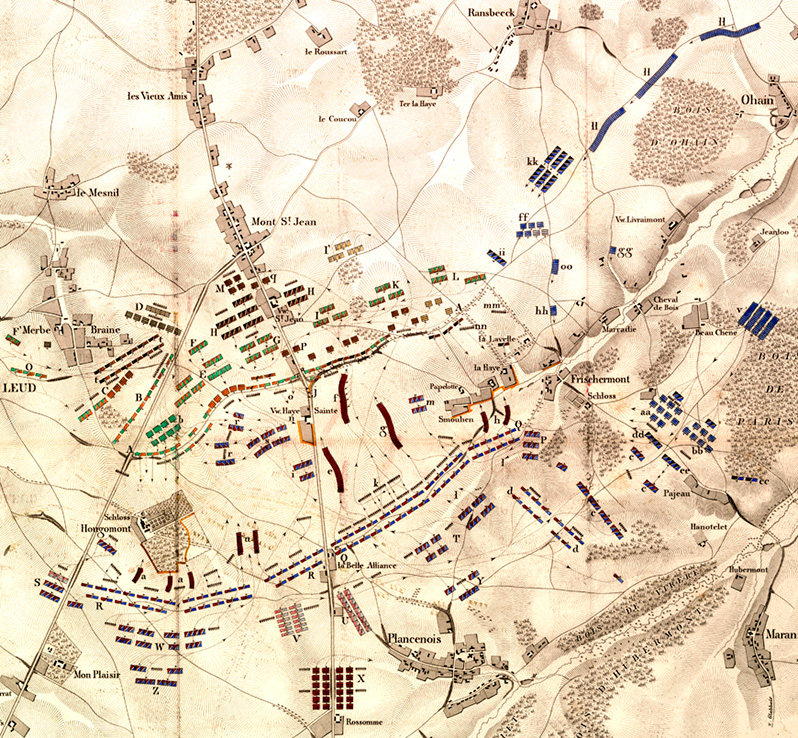
Chapter 42
The Attack of the Prussians
When Blücher saw that his corps were in no way being harassed or pursued during their retreat on the night of the 16th and on the 17th, he naturally assumed that Bonaparte had turned his whole force against Wellington. Blucher therefore decided to leave only a few battalions behind in Wavre and to hasten to help Wellington, who wanted to fight a battle [south] of the Soignies Forest. These arrangements between the two commanders were made on the 17th, and on the morning of the 18th Blücher was able to put his force in motion. The 4th Corps was to begin the march.[109] It left its bivouac at seven o'clock in the morning, went through Wavre to Saint Lambert, which it reached at noon, and concentrated there. Apparently it was already noticed in this position by the French.
The 2nd Corps was to follow the 4th Corps, and both were ordered to advance against the French right flank, that is towards Plancenoit, which would greatly endanger the French line of retreat. The 1st Corps was to march via Ohain towards the Duke of Wellington's left wing, because the duke was concerned that this flank could be turned and had expressly requested this.
The 3rd Corps was to form the rear guard, occupy Wavre with several battalions and, if no substantial enemy force appeared, make its way towards Couture, thus also towards Plancenoit. Should the enemy appear in strength at Wavre, however, the 3rd Corps was to take up a position there to stop him.
In this manner about 20,000 men provided direct support to the English left wing and 70,000 appeared on the enemy’s right flank and rear. The whole affair could not have been arranged more simply, naturally, and practically. The only possible criticism is that the 1st Corps, which had bivouaced near Bierge, was sent towards Saint-Lambert, while on the other hand the 2nd Corps, which first had to cross the Dyle, was sent to Ohain. This caused the columns to cross, and let to delay.
Various unforeseen circumstances meant that the overall march was so slow that the 4th Corps only arrived at Frischermont at 3 p.m., even though it only had to go about 9 miles. Several defiles, a fire at Wavre, repeated concentrations, and very poor roads fully explain this loss of time.
Because it followed the 4th Corps, the 2nd Corps naturally arrived on the field of battle several hours later. Due to other unforeseen circumstances, however, the 1st Corps arrived on the duke's left wing later still, in fact only around 6 p.m.
One might say that Blücher arrived too late, not because of the way things actually turned out, but just in general, given the mission. If Bonaparte had attacked in the morning, the battle would probably have been decided by the time the Prussians arrived. In that case, an attack by Blücher—while not impossible or useless—would certainly have been much less certain of success. But we must not forget that if Bonaparte had attacked earlier, everything on Blücher’s side would have been speeded up. Most of the missed opportunities that may have occurred took place before noon, before a single cannon shot had been fired at Wellington. If Wellington had already been under heavy fire at 8 or 9 a.m., Blücher's first troops would possibly have reached the field by noon or 1 p.m.
The 3rd Corps was likewise in the process of starting its march when its rear guard, which was still on the other side of the Dyle, came under pressure from a formidable enemy force, and considerable masses of cavalry showed themselves. For the time being, therefore, this corps occupied a position behind the Dyle to await further events.
The French claim that they had already observed Bülow's approach and his first position around Saint Lambert at midday. At this time—which was before d’Erlon's attack—Bonaparte ordered the 6th Corps and Subervie's and Domon's cavalry divisions, which had stood in reserve behind the center, to march in the direction of Saint-Lambert and take up a hook-shaped position approximately in line with his right wing. There is no explanation of whether or not this position had any tactical advantages, and map study alone cannot be conclusive. But if we do rely on this, then it would have been more advantageous if these troops had been placed farther forward, between Frischermont and Pajeau, anchoring their flanks in these villages.
Bülow had reached the woods of Frischermont with his first two brigades, the 15th and 16th, around 3 p.m. and had taken up a covered position which, however, could not and in fact did not conceal his presence from the French. He waited there for the arrival of his remaining brigades. But when Field Marshal Blücher saw that the French were pressing very strongly against the English center, and feared that they might penetrate it, he ordered General Bülow to attack the enemy’s 6th Corps with his two brigades and the reserve cavalry. This happened at half past four; the two other brigades followed soon after as reserves for the 15th and 16th. The enemy's initial resistance was not great, on account of Bülow's numerical superiority and the minimal advantages offered by the terrain, and the 12,000 men under Lobau were obliged to make a fighting withdrawal in the direction of Belle Alliance. General Bülow then received the order to incline his attack further to the left, in order to reach the village of Plancenoit and make it the objective of his attack. But Bülow's right wing had already become engaged with the enemy near the village of Smohain, so the 4th Corps' position became rather overextended, robbing the attack on Plancenoit of the strength which it otherwise could have had.
For his part, Bonaparte sent the division of the Young Guard to reinforce General Lobau as soon as he saw that Lobau was being forced to retreat towards the main road. The action now became a standoff because General Bülow could not advance further until he gained possession of Plancenoit. A long contest for the possession of this village ensued, with success going back and forth. Since the other two divisions of the French Guard stood close behind the village and gradually supported it with four battalions, it is easy to understand the protracted uncertainty about the results at this place, with the tide not turning in our favor until the 2nd Corps moved up and directed part of its strength against the village, whereby it fell into our hands for good. This must have been between 7 and 8 p.m.
During this struggle for Plancenoit, the French cavalry masses made their efforts against the English center, and from the other side General Ziethen arrived and advanced against the French right wing. Finally, towards 8 p.m. came the desperate gamble by the last twelve battalions of the Guard, attempting to decide the battle against Wellington. It would be very interesting to know if the Prussians were already firmly in possession of Plancenoit when Bonaparte marched off with these last reserves, throwing them into the very jaws of destruction. If that was the case, his conduct would appear even more to be that of a desperate gambler indifferent to all rational calculation.
Chapter 44[110]
Battle of Wavre on the 18th and 19th: Grouchy's March.
We have already seen that Grouchy did not arrive in Gembloux with his two corps until late in the evening, and Pajol's cavalry corps and Teste's division even spent the night at Mazy. A heavy rainstorm had soaked the roads traversing the rich farm land, and thus greatly impeded the march. It also hindered an early start. Although Marshal Grouchy says in his defense that he started the march at sunrise, Maréchal de Camp Berton, who was with the corps, states quite definitely that Exelmans' [cavalry] corps did not set off before 8 a.m. and the infantry corps only began to march between 9 and 10 a.m. [111] The truth must lie somewhere in between. The 3rd Corps, which led the way, arrived in front of the Prussian rear guard at Wavre around 2 p.m.; since it had marched fourteen miles from Gembloux to Wavre, it must have left around 6 or 7 a.m. The 4th Corps' [13th] division, under Vichery, arrived a few hours later, but the remaining two did not arrive until close to evening. All used a single road, which easily explains the late arrival, especially if one recalls all that these two corps had done during the past four days.
General Pajol was sent with his column from Mazy to Saint-Denis, Grand-Leez, and then Tourinnes, thus to the right of the main column, where he was to await further orders. From there he had to be pulled back to Wavre and did not arrive at Limale until 8 p.m., having been ordered there by Grouchy after he saw that he would not be able to break through at Wavre.
There can be no doubt that in the morning Grouchy had no clear idea of the direction that Blücher had taken with his army. Grouchy himself says this, and when he departed Gembloux, his march was directed only toward Sart-les-Walhain, not yet toward Wavre. This explains the sideward move of Pajol and the way the French were tapping blindly around, which slowed the march. It was only the encounter with the rear guard of the Prussian 2nd and 3rd Corps in front of Wavre that drew Grouchy toward that place.
This failure to recognize the true line of retreat of the Prussian army borders on the incomprehensible, since it presupposes the highest degree of clumsiness and negligence on the part of the French generals, which one is reluctant to do.
On the other hand, we do not find the slowness of Grouchy's movement toward Wavre as astonishing as most others do. In recent wars we have become accustomed to rapid movements and marches of 20, 25, or 30 miles in a single day, and therefore feel justified in demanding them, since great speed may be very valuable. But such speed results more from favorable march conditions than from the urgency of the requirement. This is all too clear to anyone who has had to deal with such matters and has had to struggle with all of the difficulties that can arise. Weather and the state of the roads, lack of rations and quarters, fatigue of the troops, lack of information, and so forth, may—despite the best intentions—reduce a march to one-half or even one-third of what was thought possible on paper. Let us take the example of the French after the battles of Jena and Auerstädt, when they were completely victorious and had the greatest reason to hasten their movements. Although they were at that time at the peak of their military efficiency, they did not exceed an average of 10 miles per day during their pursuit.
If one assumes that Grouchy's corps did not leave the field of battle at Ligny before 2 or 3 p.m. [on 17 June], then it is not surprising that these corps did not reach the neighborhood of Wavre before 2 or 3 p.m. [on 18 June], that is to say, 24 hours later, since Wavre is 25 miles from the Ligny battlefield on the road that Grouchy took, [which passed] through a range of hills; plus the conditions were very unfavorable, as we have already seen. The cavalry might certainly have begun the pursuit much sooner, but while this would not have been completely useless, it still would not have achieved the results that some commentators argue could have achieved by Grouchy with respect to the battle of Belle Alliance. The only reproach that can clearly be made against General Grouchy is that he sent his whole force down a single road, which naturally resulted in the last divisions of the 4th Corps arriving only around evening.
Chapter 45
General Thielmann's Dispositions
The Prussian 3rd Corps arrived at Wavre on the evening of the 17th, where it was rejoined by the previously detached 1st Brigade of the Reserve Cavalry. Three brigades, the 10th, 11th, and 12th, as well as the Reserve Cavalry, went through Wavre and then encamped at La Bavette. The 9th Brigade remained on the far side of the river because it had arrived too late. Together with the 8th Brigade of the 2nd Corps it now formed the advanced guard against Grouchy. On the morning of the 18th, as the 4th Corps marched towards Saint-Lambert, General Thielmann received orders to form the rear guard for the other three corps and, if no significant enemy force showed itself, to follow the others by taking the road via Couture, while leaving several battalions behind in Wavre to prevent any French patrols from causing problems on the road to Brussels while the armies fought at Waterloo. But if a considerable enemy force showed up in front of Wavre, General Thielmann was to occupy the strong position on the Dyle there and cover the rear of the army.
The departure of the 2nd and 1st Corps from the position at Wavre took until around 2 p.m. Since nothing at all had been seen of the enemy up to that time, the Prussians even more convinced that Bonaparte had turned his whole force against Wellington. General Thielmann therefore formed his corps into columns and was about to lead it down the Brussels road when a lively engagement began against the 9th and 8th Brigades, which were still on the left bank of the Dyle. General Thielmann therefore halted his troops until the situation became clearer. In the meantime, the 8th Brigade of the 2nd Corps left altogether. The 1st [Corps], which had stopped for a while, recommenced its march but left behind a detachment of three battalions and three squadrons under the command of Major Stengel at the village of Limale.
General Thielmann now occupied the Wavre position as follows: the 12th Brigade was placed behind the crossing at Bierge, the 10th to the right behind Wavre, the 11th to the left behind Wavre on the main road. Wavre itself was occupied by three battalions of the 9th Brigade, and the remainder of this brigade as well as the Reserve Cavalry were designated as the reserve and placed in the vicinity of Bavette.
The three forward brigades kept as well concealed as possible in brigade assembly areas, with the greater proportion of their force in columns, , and employed only individual battalions or half companies of skirmishers for the defense of the bridges and the river itself. Meanwhile, all of the artillery—with the exception of one battery (totaling 27 guns) kept in reserve—was spread along one side of the valley, and immediately went into action against the enemy coming down the other side.
The position of the 3rd Corps extended 2,000, from Bierge to Lower Wavre, so it was not too extensive for a corps of 20,000 men. There were four bridges across the river—one near Lower Wavre, two at Wavre, and one at the mill of Bièrge. The Dyle itself was fordable if necessary. On the other hand, the left bank of the river valley was rather high, perhaps 50 to 60 feet, and so steep that it could be considered a significant obstacle to any approach, while still offering full fields of fire. Since the countryside in the vicinity of the right and left wings was open, and some strong points presented themselves farther to the rear, the position could certainly be considered among the strongest that could be occupied immediately without much preparation.
General Thielmann's directions were designed to expose as few troops as possible, to maintain the firefight with the smallest possible numbers of infantry, and to rely mainly on artillery, so that if the enemy troops attempted to take break out of the valley by storm, he would be able to send a mass of fresh men against them. The actual reserve was to be used to attack the flank of any enemy that attempted to envelope one of our flanks.
Misfortune caused one of these arrangements to fail.
The 9th Brigade, which had withdrawn via Lower Wavre after the enemy had deployed in strength, had occupied Wavre with two battalions and placed a third behind it. Owing to some unexplainable misunderstanding, the brigade then failed to keep its remaining six battalions, two cavalry squadrons, and eight guns in reserve near La Bavette, and instead followed the other corps going via Neuf Cabaret to Couture, which had been the original destination for the whole corps. No one noticed this mistake because at the moment when General Borcke withdrew through the lines at Lower Wavre, everyone's attention was focused on the deployment of the enemy's force in front of the lines. It was not until about 7 p.m., when it was realized that the reserve might be needed, and a preparatory order was sent, that it was discovered that General Borcke had marched away instead of remaining with the Reserve Cavalry. Officers were sent out to see whether he had taken up some other position in the area, but when they returned without having found out anything, General Thielmann let the matter rest, because, as he said, the place where the heavy cannonade of a great battle could be heard was the place where the whole affair would be decided, and whatever might happen at Wavre would have no effect on that; so perhaps it was even better that another [brigade] would be there.
Thus it was that on June 18th and 19th General Thielmann had only 24 battalions of infantry, 21 squadrons of cavalry, and 35 guns, for a total of about 15,000 men, to oppose Marshal Grouchy, whose total strength could not be seen because of the woods, although about 10-12,000 men were visible by around 3 p.m.
Chapter 46
Grouchy's Attack on 18 and 19 June
The Battle of Wavre can be divided quite naturally into two different acts, namely the engagement along the Dyle from 3 p.m. until nightfall on the 18th, and then the engagement on the left bank of the Dyle, between that river and the Rixansart Woods, from daybreak until about 9 a.m. on the 19th.
On the 18th Grouchy had wanted to take Wavre with the 3rd Corps and force a passage over the Dyle there. The 3rd Corps, which was leading the way, attacked Wavre with most of its forces between 2 and 3 p.m., while somewhat later a detachment attacked the mill of Bierge. But two Prussian battalions commanded by Colonel Zepelin, which were subsequently supported by two more, maintained possession of the town and both bridges. Equally unsuccessful was the attack on the bridge at the mill of Bierge, where the 12th Brigade was defending the river crossing with only light infantry and artillery posted on the left bank. When the French 4th Corps (Gérard) arrived, a part of the [14th] Division (Hulot) was also sent to Bierge. After having been repulsed at Wavre, the French generals placed great hopes on the attack at the Bierge mill and were therefore present in person, but they were not able to gain control of this crossing, and Hulot’s division later—that is to say between 8 and 9 p.m.—moved to Limale, where it was joined by the other two divisions, which arrived considerably later after having been directed there from La Baraque.[112] Pajol also proceeded in that direction with his cavalry corps and Teste's division of the 6th Corps.
All these troops reached Limale just as darkness fell. They found the town and the river crossing undefended, probably because Colonel Stengel was already withdrawing to follow the 1st Corps. The French therefore crossed over the Dyle in the dark and pushed forward in thick masses up to Delburg on the rim of the Dyle valley, facing the right flank of General Thielmann.
It was not until around 10 p.m. that the 12th Brigade reported that the enemy had crossed the river at Limale. General Thielmann thought that it was a detached column, consisting perhaps of just one division, and ordered Colonel Stülpnagelto go there with all the forces he could collect and drive the enemy back over the river. A brigade of the Reserve Cavalry was sent at the same time. General Thielmann hurried over to the threatened point himself. The attack took place in the dark, but it was not successful, in part because the attacking battalions were thrown into disorder by a sunken road, and in part because the enemy was already too strong.
Colonel Stülpnagel was therefore forced to take up a position very close to the enemy in order to tie them down and prevent them from spreading out. The first cannon shots began at dawn, at a distance of 500 paces. A violent struggle now commenced, during which the French methodically pushed their four divisions forward under the protection of a large line of skirmishers. The 3rd Corps resisted in three different positions. The first was in the low ground near the small wood, with the 12th Brigade and Colonel Stengel, who was still nearby. The next position was between Bierge and the Rixansart Woods, with fourteen battalions of the 12th, 10th, and 11th Brigades and the Reserve Cavalry, while six battalions remained behind Bierge and Wavre, and four remained in Wavre.
The resistance in this second position lasted the longest, and it was here that General Thielmann learned that the battle [Waterloo] had been won and that the Prussian 2nd Corps had been ordered to take his opponent in the rear by advancing via Glabaix and La Hutte.
These places were so far from the field of battle that General Thielmann could expect no assistance, so he could only hope that his opponent had also heard of the outcome of the great battle, and would quickly begin to retreat out of fear of being cut off. General Thielmann therefore had his troops shout loud hurrahs and show signs of rejoicing. But this hope was in vain. The enemy continued to press forward, and General Thielmann was forced to retire further, and finally to begin a general retreat in which he also ordered Colonel Zepelin to withdraw from Wavre.
General Thielmann withdrew in the direction of Louvain as far as Saint-Achtenrode, three hours’ march from the battlefield, and lost only a few thousand killed and wounded. The 3rd Corps’ 9th Brigade had continued its march towards Saint-Lambert, spent the night of the 18th in the woods there, marched back towards the cannon fire of Wavre early on the 19th, and finally reunited with the rest of the 3rd Corps at Gembloux on the 20th after passing through Limale.
Chapter 47
The Action at Namur
Grouchy actually seems to have received the news of the loss of the Battle of Belle Alliance on the morning of the 19th, just about the time that Thielmann began his retreat. This made his opponent's withdrawal easier, since Grouchy lost any desire to continue seeking small advantages at a time when he had to be greatly concerned about his own retreat. He realized that he could no longer head for Charleroi and thus resolved to go to Namur. At midday he sent Exelmans' cavalry corps ahead, which is supposed to have arrived at 4 p.m., though this seems doubtful since the battlefield of Wavre is almost thirty miles from Namur. The infantry followed at nightfall in two columns, one via Gembloux, the other by the most direct route. The cavalry divisions of Maurin and Soult formed the rear guard.
The French infantry reached Namur between 8 and 9 a.m. [on the 20th].
General Thielmann reached the area of Achtenrode around noon [on the 19th]. He had decided that under no circumstances would sent his utterly exhausted troops to pursue the enemy that day, as they were greatly in need of rest and it could be foreseen that the enemy's rear guard would not withdraw before nightfall, making it impossible for an advance to be decisive. He therefore preferred to have his troops rendezvous at daybreak near Ottenbourg, where his advance guard was placed, in order to advance in good time in pursuit of the enemy. Assembling the force was delayed for about an hour, and at around 5 a.m. the cavalry set forth via Gembloux on the road to Namur, with the infantry following.
The cavalry first encountered enemy cavalry at Gembloux, but these immediately withdrew. The pursuit proceeded as quickly as possible on the most direct route to Namur, but the Prussians did not find the enemy again until they were about 45 minutes from town.
General Thielmann's cavalry thus covered the distance to Namur in five or six hours, while the infantry remained at Gembloux.
Several enemy battalions along with some cavalry and artillery were encountered in front of Namur. They were attacked, lost three guns, and withdrew closer to the town.
Some masses of enemy troops stood on the Brussels-Namur highway, apparently to cover a retreat. While they were being observed, an enemy division, marching in column, was discovered on the road itself. As soon as they spotted General Thielmann's cavalry, they formed squares, placed artillery and skirmishers out on the left, and under this cover continued their march into the city. It was the last division of the 4th Corps, which arrived at Namur a little later than the 3rd. Almost immediately afterward came General Pirch with the Prussian 2nd Corps.
After the battle [of Waterloo] this general had received orders to proceed toward Gembloux and fall on Grouchy’s rear. He had marched all night, passing through Maransart and Bousval, and reached Mellery on the morning of the 19th. Here he bivouacked and sent out patrols. However, as these brought no news of either General Thielmann or the enemy, he remained there through the night and only set out for Gembloux after receiving a report, at five in the morning on the 20th, that the enemy was retreating through that place. Thus it was that he ended up hanging on to the tail of the column of the French left wing. When this column withdrew into the town, General Pirch tried to gain possession of the Brussels gate. But because the gate and the remaining pieces of the ramparts connected to it were strongly held by enemy infantry, a very sharp infantry action took place, which lasted several hoursand is supposed to have cost the 2nd Corps 1100 men killed and wounded, without achieving anything. The effort had to be abandoned, and the enemy did not leave the town until 6 p.m., heading towards Dinant, where it was followed, on Blücher’s orders, only by Colonel Sohr's brigade of cavalry.
If General Pirch had continued his march toward Namur and gotten there before Grouchy's infantry, as he well might have, Grouchy would have had way to cross the Meuse, and would have had to turn towards Charleroi. This would have happened on the 20th. On that day the Prussian 1st Corps, having followed the defeated main French army through Charleroi, had already there and was near Beaumont. On hearing the news of Grouchy's move, it would probably have given up its advance towards Avesnes and turned towards Philippeville. But it is very unlikely that it could have cut off the retreat of Grouchy's corps, since Grouchy would have reached Philippeville first, and in the worst case could have gone to Givet. Nevertheless, Grouchy might have suffered greater losses, as individual units would have been cut off, etc. Things would have turned out quite differently if the Prussian 1st Corps had been ordered to remain on the Sambre on the 19th and 20th in order to block Grouchy. In that case 50,000 men would have been united against this marshal on the morning of the 21st, and it is hard to believe that he could have avoided capitulating, penned in as he would have been by this superior force and two rivers. Bonaparte himself said in a letter written at Philippeville to his brother Joseph, "I have heard nothing from Grouchy at all. If he has not been taken, as I fear, I can have 50,000 men in three days."[113] But of course early on the 19th—when these dispositions would have had to have been made—Blücher's headquarters knew far too little about Grouchy's situation to make cutting him off a major objective of immediate operations.
In any case the attack on Namur is hard to justify, since little would have been gained by forcing a way into the town and just beyond the town was the bridge over the Sambre, [whose destruction by the French] could have put an end to all further pursuit. On the other hand, another passage over the Sambre could probably have been found; and because the the Namur-Dinat road runs on the left bank of the Meuse, that is to say in a deep and steep valley between the two rivers (in effect a continuous defile), then if the Prussians had gained control of the heights they could have greatly impeded the French retreat, inflicting heavy losses upon Marshal Grouchy, and above all delaying his retreat, thus preventing him from reaching Laon before the Allies. But in war it is seldom the case that everything is done that can be done. The mission that was here assigned to General Pirch was in no sense routine; rather it required an exceptional degree of energy.
Chapter 48
Reflections on the Battle: Bonaparte
If we take a probing look at the outcome of the great drama which took place on the 17th and 18th of June, we must focus our attention on the following subjects:
1. First we must ask: could and should Bonaparte have attacked in the morning instead of at midday on the 18th? His entire offensive against the allied field armies had to be conducted with the greatest speed if it was to succeed, since he wanted to defeat them one at a time, if possible even before they had completely assembled. One might even criticize him for having already lost a few too many hours on the 16th. However, his troops' need for rest, coupled with various measures and preparations required for strategic and practical reasons, are sufficient to explain why the attack on the 16th did not take place earlier, and on the whole critics far away in place and time are rarely in a position to argue over a couple of hours. But on the 18th there really does not seem to be sufficient justification for delaying half a day. Bonaparte arrived in front of Wellington's position on the evening of the 17th and even regrets in his memoirs that he did not have a few more hours of daylight so that he could have started the battle on the 17th.[114] There was thus no reason why he could not have set his columns in motion at daybreak on the 18th, which would have allowed the battle to start at around 6 or 7 a.m. Under such pressing circumstances, 4 or 5 hours of rest would have to suffice for the troops. Bonaparte had two things to fear: first, the complete concentration of Wellington’s army, and second, Blücher participation in the battle. A rapid attack was the only means of dealing with either. But Bonaparte did not believe that Wellington would accept battle if he was waiting for more troops to arrive, and he thought it even less likely that Blücher would be able to come quickly to Wellington's aid.
Bonaparte therefore thought that a few hours more or less were not significant. We personally do not believe that an attack early that morning would have guaranteed victory, because we know that Wellington did not receive any more reinforcements in the course of the day. Furthermore, if the battle had begun at 6 or 7 a.m., Blücher would probably have arrived 3 to 4 hours earlier, thus still in good time. But what we know now was hidden from the French commander at that time, and neither of his assumptions concerning Wellington and Blücher proved to be well founded.
In looking at the unnecessary assembling and parading of his army, through which Bonaparte lost several hours of time, one might almost suspect that his aim was not a battle but an English retreat, which he hoped to achieve with this bombastic display. But such a wish would have been so contrary to his interests under the circumstances, and also so far removed from his previous methods, that it could only be seen as the result of an inner crippling and dimming of his spark of genius. All of this would only be a fleeting thought, an unproved suspicion, a mere premonition of the truth, and it would scarcely be permissible to include it in the list of observations were it not for the fact that another consideration, of which we shall speak in a moment, also leads to the same conclusion.
2. The second issue to consider is the role that Bonaparte wanted his right wing to play in the battle. We regard his entire account of this as completely dishonest, a scheme conceived only after the fact. Grouchy's situation and the way Bonaparte uses it in self-justification, is very similar to Ney’s situation on the 16th. On that occasion the left wing originally was only supposed to stop the British, or perhaps force their leading divisions to move back somewhat.Only later, when it was obviously too late, did it receive the completely unrealistic order to take part in the main battle itself. Similarly, on the 17th the right wing under Grouchy was only supposed to pursue the defeated Blücher, to prevent his forces from assembling, recovering, or even turning back, and it was only later—and once again too late and contrary to the true nature of the situation—that Grouchy received the order to participate in the main battle. According to Grouchy's account in his own defense,[115] there is no order listed in the order book of the chief of staff, Marshal Soult, as having been sent to Grouchy on the 17th. The instructions that he received concerning the pursuit of the Prussians consisted solely of those given to him verbally by Bonaparte on the battlefield of Ligny, in the presence of General Girard.
On the other hand, we find two letters from Marshal Soult to Grouchy on the 18th, which read as follows:
1. To Marshal Grouchy
(carried by the aide, Major Lenovich)
In front of the farm of Caillou, 18 June, 10 a.m.
Marshal, the Emperor has received your last report dated from Gembloux. You speak to his Majesty of only two Prussian columns that have passed at Sauvenières and Sart à Walhain. However, other reports say that a third column has passed at Gery and Gentinnes, heading toward Wavre.
The Emperor directs me to tell you that at this moment his Majesty is going to attack the English army, which has taken position at Waterloo near the Soignies Forest. Thus his Majesty desires that you direct your movements on Wavre in order to draw near to us, place yourself in touch with our operations, and link up your communications with us, driving before you those portions of the Prussian army that have taken this direction and may have stopped at Wavre, where you should arrive as soon as possible. You will follow the enemy's columns on your right, using some light troops to observe their movements and gather up their stragglers.
Inform me immediately about your dispositions and your march, also about any news of the enemy, and do not neglect to link up your communications with us. The Emperor desires to have news from you very often.
Signed, Chief of Staff, Duke of Dalmatia
2. From the battlefield of Waterloo the 18th at 1 p.m.
Marshal, you wrote to the emperor at 2 o'clock this morning that you will march on Sart à Walhain, thus your plan is to proceed to Corbaix or to Wavre. This movement conforms to his Majesty's arrangements which have been communicated to you.
Nevertheless, the Emperor directs me to tell you that you should always maneuver in our direction. It is up to you to see where we are located in order to regulate your movements accordingly, and to link up your communications with us so as to be always ready to fall upon and wipe out any enemy troops that may attempt to annoy our right flank. At this moment the battle is in progress on the line of Waterloo. The enemy's center is at Mont-Saint-Jean, so you should maneuver to join our right.
Signed the Duke of Dalmatia
P.S. A letter that has just been intercepted says that General Bülow is about to attack our flank. We believe we can see this corps on the heights of Saint-Lambert, so do not lose an instant in drawing near and joining with us in order to crush Bülow, whom you will catch en flagrant délit.
In contrast, Bonaparte maintains that at 10 p.m. on the evening of the 17th he sent an officer to Grouchy:
to inform him that he had the intention of fighting a great battle on the morrow, and that the Anglo-Belgian army was in position in front of the Soignies Forest, anchored on its left in the village of La Haye, and that Marshal Blücher would certainly operate in one of the following three directions:
1. retreat toward Liége;
2. advance toward Brussels ; [or]
3. remain in position at Wavre.
In all three cases he would have to maneuver via Saint-Lambert in order to overrun the left wing of the English army and join with the right of the French army. In the first two cases, however, he would have to execute his movement with the bulk of his forces combined, and in the third it would only be necessary to leave a detachment, whose strength would depend upon the nature of the position, in order to occupy the front of the Prussian army.[116]
Furthermore, Bonaparte asserts that he repeated this order in a duplicate sent early on the morning of the 18th. Bonaparte immediately adds, however, that Marshal Grouchy never received these two orders. The marshal, on the other hand, declares his conviction that they were never even sent,[117] and in reality a closer examination of the issue seems to support this view because:
1. The orders are not contained in the chief of staff's order book.
2. The two letters by Soult on the 18th do not mention them and are not even consistent with them.
3. It is unlikely that two separate letters carried by officers would both be lost. One must ask if the officers also were lost.
4. Bonaparte should have named the officers who were supposed to have carried these orders.
5. It is revealing that the statement that Grouchy did not receive these orders comes from Bonaparte.
6. It is curious and most suspicious, that on the 16th a similar order failed to reach Marshal Ney.[118]
At any rate, Marshal Grouchy is correct when he states says that he cannot have been expected to carry out orders that even Bonaparte says did not reach him, and that he could therefore only act on the basis of the verbal instructions that Bonaparte gave him around midday on the 17th. Bonaparte had told Grouchy on the evening of the 16th, when the latter asked for more instructions, that they would come on the following morning. Grouchy then states:
I was at his headquarters the next morning before sunrise, waiting for orders. Around 7:30 he sent word through the chief of staff that he was going to visit the battlefield and I should accompany him.
Meanwhile, General Pajol, who had been ordered to pursue the Prussians with his light cavalry and a division of infantry, was just then sending back several cannon captured on the road to Namur. This circumstance may have led to the belief that Blücher was retiring toward that town.
Between 8 and 9 a.m., Napoleon left Fleurus in his carriage to go to the battlefield. The difficult condition of the roads, across fields cut by ditches and deep furrows, delayed him so much that he decided to mount his horse. Arriving at Saint-Amand, he had himself guided around the diverse avenues by which this village had been attacked the evening before. Then he walked on the battlefield, stopping to care for and question several wounded officers who were still there, and passing in front of the regiments who formed up without arms on the fields or who were bivouacked there, saluted them and received their acclamations. He spoke to almost all of the corps with interest, expressing satisfaction at their conduct the evening before. He then dismounted and spoke for a long time with General Gérard and myself about the state of opinion in the Parisian assembly, the Jacobins, and diverse other subjects; all of which were extraneous to that which seemingly should have occupied his thoughts exclusively at such a moment.
I am entering into such minute details because they serve to reveal how that morning was spent, the loss of which was to have such disastrous results. It was not until midday, after having received the report from a patrol that had been sent to Quatre-Bras, that Napoleon began to issue orders relating to the dispositions he intended to adopt. He then put into movement the corps of infantry and cavalry that he wanted to take with him and directed them toward the route to Quatre-Bras, and afterward gave me the verbal order to take command of the corps of generals Vandamme and Gérard and the cavalry of generals Pajol and Exelmans and to pursue Marshal Blücher.
I then commented to him that the Prussians had commenced their retreat at 10 p.m. on the night before, and that considerable time would be needed before the troops could be put into motion, for they were scattered across the plain and had disassembled their arms for cleaning and were making their soup and were not expecting to march that day; also that the enemy were 17 to 18 hours ahead of the corps that were being sent after them; that although the reports of the cavalry did not give any more precise details on the direction taken by the mass of the Prussian army, it seemed that Marshal Blücher’s retreat of was in the direction of Namur, and that in pursuing him, I would therefore find myself isolated, separated from [the emperor] and outside the radius of his operations.
These remarks were not well received. He repeated the order that he had given, adding that it was up to me to discover the route taken by Marshal Blücher, that he was going to battle the English, that I was to complete the defeat of the Prussians by attacking them as soon as I had reached them, and that I was to communicate with him via the paved road which led from a point not far away from that on which we found ourselves at Quatre-Bras. The brief conversation that I then had with the chief of staff [Marshal Soult] concerned only the extraction, from the corps under my command, of the troops to be sent toward Quatre-Bras. . These are word for word the only directions that were given to me, and the only orders I received.[119]
On the basis of Marshal Grouchy's recounting of what occurred with Napoleon on the morning of the 17th, one sees:
1. that in all probability this marshal truly received no instructions for his actions on the 17th other than a very general one to pursue the Prussians;
2. that Bonaparte had no idea that the Prussians were withdrawing toward the Dyle and even saw some merit in the view that they were heading toward Namur; therefore he did not direct the marshal toward Wavre;
3. that at 10 a.m. on the 18th Bonaparte did have a report that one Prussian column had gone to Wavre, but that he still believed the main portion had gone toward Liège, and therefore that General Grouchy would undoubtedly be able to drive the Prussians from Wavre and place himself between Bonaparte and the Prussians;
4. that Bonaparte truly demonstrated a kind of lethargy and carelessness that corresponded neither with the position he was in nor with his previous methods. This is the second sign that causes us to think that something had changed within him.
If he had wanted his cavalry to take up the pursuit that evening, why not have them mount up at daylight on the 17th to look for the missing Blücher, so as to at least be clear about the direction he had taken, and thus about the best direction to send the force directed against him? Why does he drag the general who is supposed to lead the pursuit around with him for 3 or 4 hours without sending him off on his mission, and how could his thoughts be so occupied with things occurring in Paris that he lost sight of the most essential elements of the conduct of war?
In any case, the whole story leaves the impression that Bonaparte had undoubtedly written off the Prussians, and no longer thought that any further fighting against them would matter in relation to the battle that he was now about to fight with Wellington. Thus there was no thought that either Blücher or Grouchy would participate in the battle that was about to take place on the road to Brussels. Bonaparte's assertion that he viewed the separation of the opposing forces on the 17th as two columns heading toward Brussels, one consisting of Blücher and Grouchy via Wavre, the other of Wellington and himself via Mont St. Jean, is just a view he patched together afterwards, and would not be worth mentioning if it had not been taken up by other writers.[120]
Now that we have shown that, in all probability, the participation of the right wing in whatever was going to happen on the left did not occur to the French commander at all on the 17th, which is to say, in time to matter, we must look more closely at the nature of the assistance that was ordered on the 18th, much too late.
If on the 17th Bonaparte had ordered Marshal Grouchy not to pursue and press Prince Blücher on all of his avenues of retreat, but merely to observe him while always staying between the main [French] army and Blücher, then Grouchy could have played a role on the 18th, either by placing himself in front of the advancing Blücher or, if Blücher did not advance, by detaching forces toward Mont-Saint-Jean. This role is clearly completely different from one of pursuing and pressing. Such an order would naturally have led Grouchy to the Dyle, because this river was a key terrain feature separating the two allied armies; but the route would not have been by way of Gembloux, but rather by way of Tilly in order to reach the left bank as quickly as possible. If the Prussians remained on the right bank of the Dyle, then Limale and Wavre would have been the natural assembly points for Grouchy. If, however, he heard that the Prussians had headed for Wavre, then the area around Neuf-Cabaret, or anywhere else [that kept] his right wing on the Dyle and his front parallel to the road from Wavre to Brussels, would have been a good position from which to hold Blücher in check, get in front of him, or remain on his flank.
In this position Grouchy would have been only around 4 or 5 miles from Bonaparte, and could have kept in direct contact through the usual flank patrols. It would thus not have been impossible for Grouchy to have been under Bonaparte’s direct orders, even on the day of the battle.
In contrast, following Blücher via Gembloux, without any intervening forces [between himself and Bonaparte], was a huge divergence that not only placed Grouchy's force even farther away from the main army, but also made communications with it very difficult, even uncertain, because of the circuitous path that was required. Thus we see that an order written at 1 p.m. on the 18th did not reach Grouchy's hands until 7 p.m. This is not surprising, because the chief of staff had found it necessary to send the officer carrying this order via Quatre-Bras and Gembloux; he therefore had to travel about 30 miles. How can a corps that can not receive orders in less than 6 hours be considered part of one and the same battle? How can a commander claim to be able to lead such a corps from the battlefield, based on constantly changing information on that very day? But that is how it looks when we read the end of the second letter:
At present the battle is in progress on the line of Waterloo. The enemy's center is at Mont-Saint-Jean, so you should maneuver to join our right.
and even the postscript:
A letter that has just been intercepted says that General Bülow is about to attack our flank. We believe we can see this corps on the heights of Saint-Lambert, so do not lose an instant in drawing near and joining with us in order to crush Bülow, whom you will catch en flagrant délit.
If Grouchy had received this order at 4 in the afternoon, which in this case would have been quite unlikely, and if the marshal had been able to start his march right away, he still would not have made it from the Wavre area to the vicinity of the [Waterloo] battlefield before 9 p.m., for one does not march with 40,000 men through rough terrain in the presence of the enemy at the same speed as one man alone, and the distance that Grouchy had to cover was more than 9 miles.. If we consider the many instances of lost time that are a constant occurrence in warfare, and must always be taken into account, then the order to Grouchy cannot be taken seriously. And what does that order presuppose? That Grouchy was not occupied with the enemy and was ready to march at a moment's notice. But Grouchy had in fact been ordered to pursue Blücher, and Bonaparte therefore had to expect that Grouchy's forces would either be engaged in close combat, or spread out over a number of roads in the course of the pursuit. Either way it would be quite unreasonable to expect that he would be ready to march off at once to the battle of Waterloo.
The truth is that when Bonaparte heard on the [morning of the] 18th that part of the Prussians had gone to Wavre, he began to be concerned that they could support Wellington, but he considered this column to be only a small fraction of the Prussian army, which Grouchy could easily drive away. Only [later in the day] did Bonaparte begin to realize the importance of having Grouchy between himself and the Prussians, and only then did his directives begin to have the tone that they would have had from the very beginning if, on the 17th, he had given Grouchy an order like that we have shown on above, which is to say, if his arrogance had not led him to count Blücher out. As his position worsened in the battle he transformed the idea of having Grouchy between himself and the Prussians into a different one, that Grouchy was nothing more than the right wing of his own line of battle, and that he could be called over to fall upon the rear of the Prussian corps that had arrived alongside the English. But armies do not move like thoughts, and if one starts off with false assumptions, one must generally bear the consequences.
Bonaparte has always spoken only of Bülow, as if the rest of the Prussians were incapable of further action after the battle of Ligny. But this was a foolish assumption that was in no way justified by the outcome of that battle and the small number of trophies taken. In assuming that what was visible at Saint-Lambert could only be Bülow, not Blücher, Bonaparte had even less reason to believe that Grouchy would thereby be drawn toward him as well, because Grouchy had been sent out against Blücher, not Bülow, and had to be considered as engaged with the former, not the latter.
From our perspective the result of these considerations is:
1. that on the 17th Bonaparte did not expect Blücher and Grouchy to participate in the battle on the 18th, that he had not even considered it, and that—when the overall arrangements are considered—he was completely surprised by Blücher's appearance on the 18th.
2. that the orders on the 18th calling for Grouchy to participate [in the battle of Waterloo] seem to have been last-minute expedients issued in desperation, and could not possibly have been carried out.
So much for Bonaparte's characterization of his right wing's relationship to the battle [of Waterloo ]. We will look at Grouchy's actions later.
Now let us look at the battle itself, which leads us to the following observations.
We can discern nothing about an actual plan of attack. The deployment and advance of the French army take place parallel to the enemy front and the distribution of forces is practically uniform along the entire line. At the same time it seems that the attacks on the advanced post of Hougoumont and the village of La Haye had so little energy, and the attack on the center was so large, that Bonaparte's intention must have been to break through the Allied army in the center, while merely keeping it occupied on the flanks. Since the main avenue of retreat was directly behind the center and it is generally assumed that the other entrances into the Soignies Forest were not suitable for all arms, such a breakthrough in the center would indeed have had decisive results, and there was certainly no other way to bring about a total defeat of the Allied army so quickly. If one considers that Bonaparte had the 6th Corps following in the center, and also that the Guard was behind the center, then one call well imagine such a plan being successful. Specifically, if the 3 divisions of the 1st Corps, which formed the attack on the center, could substantially weaken and drain the strength of the Allies through several hours of fighting, then the 6th Corps could move forward for the moment of decision and make the actual breakthrough, with the Guard in reserve in case Wellington's flank forces attempted to improvise an attack on the French flanks. Such a spur of the moment reaction [by Wellington] is seldom very sustained or strong, so the French Guard would probably have been able to withstand this thrust, and victory in the center would have continued to develop and become more dangerous for Wellington.
Thus one can imagine Bonapart’s attack being crowned with a spectacular triumph; but the essential factors should not be mixed up or placed in false relationships to each other.
Against forces in extended positions in hilly country, where everything seems to be nailed in place and a counteroffensive is not realistic for several reasons, a breakthrough in the center is the simplest, most decisive and least dangerous form of attack.
But this is not the case for a position with great depth, owing to concentrated forces or the presence of large reserves. In that case breaking through in the center—if successful—may still be the most decisive course of action, but it is also the most unnatural and dangerous one, because:
1. The attacker does not have the extended space in which to mass far superior forces at the decisive point.
2. It is much harder for him to hide his intentions and dispositions.
3. If the opponent goes over to an attack on the flanks, this leads to the most disadvantageous form of battle.
If battles still consisted solely of an instantaneous blow,[121] and if armies were like brittle objects whose crystalline structure could be smashed by such a blow, then there would be little reason to consider the third of these disadvantages. But our battles last for half or even a whole day; for the most part they are a slow grinding and consumption of the two armies, whose fronts touch each other like two hostile elements that destroy each other wherever they meet. Thus the battle burns slowly and with limited intensity, like wet powder, and only when most of the opposing forces have already been burned out into useless cinders is a decision achieved by what is left. In this kind of warfare, a thrust by a reinforced center, like a battering ram against the enemy front, is actually a very unrealistic form of attack.
We often hear it said that breaking through in the center was Bonaparte's favorite maneuver. Bold, ruthless, overpowering and arrogant as he was, and always thirsting for the greatest triumphs, one could well believe that he must have preferred this form of attack. However, if we look at all the important battles in which he was the attacker, we see that such an assertion is completely unfounded.[122]
Perhaps more than anything else, this proves just how unnatural a thrust at the enemy center is, and how strongly the attacker is always drawn to the flanks.
If we nevertheless regard a French victory at Mont-Saint-Jean as possible, it is only because we believe that 70,000 Frenchmen led by Bonaparte and Ney were more than a match for 70,000 Allies, of whom a third consisted of Hanoverian militia and new units, and a third of Belgian units that had just been formed, and whose officers and men could not be trusted. These units melted away in the battle much faster than the French, as is confirmed by all eyewitness accounts. The fact that Wellington's position was so precarious at around 5 p.m., despite the fact that not a single man from the 6th Corps or Guard had fought against him, clearly shows the superiority of the French troops.
If we therefore believe that the thrust against Wellington's center could have succeeded, it is only because:
1. we think the quality of the troops was so disparate, and
2. Wellington does not seem to have considered or prepared for a counterattack.
Under these circumstances, it is difficult to consider the wedge-shaped thrust against Mont-Saint-Jean as a mistake for a commander like Bonaparte, who must always have his eye on the boldest strokes in order to achieve spectacular results.
But this is only correct if the 6th Corps and the Imperial Guard are included. Once Blücher appears, and the entire 6th Corps as well as half of the Guard must be used against him, then this thrust at the center truly becomes no more than a melée, a wild attempt at overrunning the enemy. This is also a fair characterization of the premature and wasteful employment of the cavalry. From this point onward nothing is in its proper relationship: the forces on the flanks are just as strong as those in the center, so there is no superiority in numbers, and therefore no basis for success. The fact is, no matter how much Wellington's army had melted away, or how threatening the position of the French cavalry confronting Wellington's line may have been, Wellington's reserves were not yet exhausted, and if no large masses of fresh troops followed the French attack, then these tremendous endeavors were just wasted effort. Thus because Bonaparte lacked the forces to prepare the attack on the enemy center properly, as one must nowadays prepare every attack, and because he lacked time and therefore had to do everything too hastily, he was no longer carrying out a carefully planned and properly executed plan, but basically acting in sheer desperation.
We can therefore see that Blücher’s arrival did not just snatch victory out of Bonaparte’s hands, which would have also been the case had Turenne, Frederick the Great, or any other great commander placed in the same situation. It also provoked the emperor into hurling his forces in helpless rage against Wellington’s rocklike stand, shattering them, and thereby placing them in a state of complete disintegration as this remarkable day ended.
4. Most critics have claimed that Bonaparte should have attacked Wellington's left wing and enveloped it.
Wellington's left wing was weak in and of itself, and if one completely ignores the possibility of Blücher's assistance, then such an attack would seem to be much easier—although less decisive—than one against the center. If Bonaparte considered Blücher’s appearance to be more or less impossible, then there would have been much to say for this course of action. However, if one does consider the possibility that the Prussians could advance via Lasne and Saint-Lambert, then it is clear that an attack on the left flank would have been just about impossible.
The right wing of Wellington's army was stronger than the left due to the terrain, because near Braine-l'Alleud and Merbe-Braine there are a considerable number of depressions that greatly hinder an attack. Also, an attack on this side, that is to say against the right wing and on the right flank would have taken several hours longer, which in Bonaparte's position was a particularly weighty consideration. Furthermore, he would have completely given up his natural line of retreat, and if defeated he would have had to fall back through Mons toward Maubeuge or Valenciennes. Finally, such an attack would obviously have been the least decisive of all, because even if successful it would have neither split Wellington's army nor separated him from Blücher. These considerations are so numerous and important that in most cases the idea of attacking from this direction would have to be set aside completely. However, if we accept that Blücher’s arrival with a significant force (c. 50,000 men) was sufficiently possible that it had to be taken into consideration for planning purposes, and that [if he were to appear] neither an attack on the center nor on the left wing offered any possibility of victory, then we must return to the attack on the right wing, because having at least some chance of success must be the highest priority.
If Bonaparte had marched his army to the left and had advanced against Wellington's right flank via Braine-l'Alleud, Wellington would have been forced to form a new front toward the west. In that case Wellington would have had a front that was perhaps even stronger, but there would have two important advantages for the French. First of all, in this position Blücher would most likely not have been able to fall upon the French right flank, but would have supported his ally from the rear; the battle would thus not have taken on such a disadvantageous form for the French. Second, the Soignies Forest would have been on Wellington’s right flank, and as he had always shown great sensitivity and concern about the road to Brussels, Bonaparte could have exploited the woods to cause Wellington to occupy it strongly, thus splintering his strength. Then the French would not have faced such a deep and dense position, and would have encountered less resistance.
A complete defeat of Wellington was unlikely in this case, but there could still have been a blow comparable to the one against Blücher at Ligny, which might have led to disunity and indecision between the two allied leaders. Grouchy's appearance in Blücher's rear on the 19th could then have achieved all that for which there was not enough time left on the 18th. Both allied commanders had already abandoned their natural lines of retreat, and this had to cause uneasiness with their situation and weaken their resolve. In short, it is quite possible that if [the two Alliend commanders] were not able to wrench a victory out of their opponent's hands on the 18th, there could have been a parting of the ways that would have been the overture to much greater results.
Therefore we believe that an attack on Wellington’s left wing and in the left flank was the least feasible. One against the center was the shortest and most decisive, and it was feasible as long as there was reasonable assurance that it could be completed before Blücher arrived. But if an early and powerful appearance on the part of Blücher had to be taken into account, then an attack on the right wing and the right flank offered the only hope of victory.
5. Napoleon's failure to garrison the valley of Lasne and Saint Lambert immediately with some light troops may have been a mistake, but it would not have made much difference to the overall outcome of the battle. Deploying an entire corps like the 6th in that area would have required a completely different plan, a completely different point of view than that of Bonaparte. Admittedly Lobau[‘s corps] could have offered stronger and longer resistance at Lasne and Saint-Lambert than at Frischermont, but he would have been attacked much earlier, and if Blücher had advanced forces by way of Couture, then Lobau would have been in danger of being cut off completely. In that case Bonaparte would have been forced to send more troops to this area, and in short would have found himself fighting on a battlefield twice as large, which would not have been to his liking and which he would have had great difficulty controlling. On the other hand, it does seem that Lobau's corps would have been better positioned between Frischermont and Pajeau, making that its main line of resistance.
6.[123] Finally, our last observation about the battle from Bonaparte's perspective concerns the previously mentioned use of the last reserves. A cautious commander like Turenne, Prince Eugene [of Savoy], Frederick the Great, who would not have found himself in such an extraordinary position, and who would have had either a greater sense of responsibility or more to lose, would not have fought the Battle of Belle Alliance. That is to say, at noon, when Bülow appeared, he would have broken off the engagement and withdrawn. If it were possible to confine the rules for the conduct of war to merely objective relationships, one would say in this case that it was against all the rules [for Bonaparte] to try to carry on with the battle. Earlier critics would not have failed to point this out, but would also have added that a genius cannot be bound by the rules. But we do not share this opinion. If the conduct of war should for the most part be based on fundamental principles, then these must encompass every situation in which a warring party can find itself, and in particular the greatest and most far-reaching situations.
Bonaparte was balancing on the tip of his sword not only the crown of France but a number of other crowns as well, and by relying solely on daring and bold defiance he had made his way through a world of fixed relationships and rules that constantly opposed him. How can he be measured on the same scale as a Turenne, who belonged to a comprehensive political order that defined him far less than he defined it, and who can merely be seen as one of its more prominent members? How can one criticize Bonaparte for not avoiding a battle, even though he saw on his flank the flash of the sword that Blücher had drawn—thirsty for revenge—and realized how little hope of victory remained? After all, this was the only path to his goal, the last hope remaining at a time when his fate was hanging from a slender thread. As he advanced toward Wellington, with victory almost certain, something like 10,000 men appeared on his right flank. The odds were 100-to-1 that another five to six times as many would follow them, and then the battle could not be won. But it was also possible that those troops were only a small detachment, and that uncertainty and caution would prevent them from intervening effectively. Otherwise, all that lay ahead for him was inevitable ruin. Should he allow what was simply a dangerous situation to scare him into certain defeat? No, there are situations when the greatest prudence can only be sought in the greatest boldness, and Bonaparte's situation was one of them.
Thus we judge his perseverance in his decision to give battle, and it therefore remains for us to show, from [Bonaparte’s] point of view, that our disapproval of his sacrifice of the last reserves is not based on mere normal caution. As Blücher's forces grew to between 50 and 60 thousand men, as Lobau was overwhelmed and forced back to the main line of retreat, as new, dark-coated masses under Ziethen moved into the empty spaces in Wellington's line as night began to fall, ending any hope that Grouchy might come to his aid, there could no longer be any thought of victory. His duty as commander—as well as the wisest course of action—was to throw part of his reserve against Bülow to relieve the situation and gain room for a retreat, and then to begin withdrawing immediately, covered by the rest of the reserve. The battle was lost, perhaps a complete downfall no longer avoidable, but for Bonaparte's subsequent dealings there was still a huge difference between being overwhelmed by far superior numbers, and making a brave, fighting withdrawal from the battlefield at the head of his indomitable band, or returning [as he did] as a virtual fugitive, burdened with the reproach of having ruined his entire army and then abandoned it.
Bonaparte may have never made a greater mistake. Clearly a commander will not win very many battles if he gingerly pulls out of the struggle whenever the scales tip slightly against him, and such a view of battle is incompatible with Bonaparte's art of war. Quite a few [of his] victories were only achieved through perseverance and the efforts of the last reserves of strength; but a critic can demand that a commander not seek to attain the impossible, and in so doing sacrifice forces that would better be employed otherwise. In this case Bonaparte does not seem to be acting in the manner of a great man but rather in vulgar exasperation, like someone who has broken an instrument and in his anger smashes the parts to pieces on the ground.
Chapter 49
The Allies
We have little to say about the conduct of the allied commanders in the Battle of Belle Alliance.
Wellington's position was by all accounts very favorable. As for the alleged danger posed by the forest of Soignies Forest lying close to his rear, one must first look at the condition of the secondary roads before making any judgment. It has always seemed unlikely to us that in this cultivated area such a small forest would be difficult to pass through. If this was not the case, then having the forest nearby was advantageous.
One of the chief virtues in the duke’s dispositions is his numerous reserves, or in other words, the limited extent of his position in relationship to the size of his army, which allowed many troops to be left in reserve. However, more could have been done to prepare and fortify the three forward posts.
In deploying his divisions the duke sometimes split them apart completely. Very likely he did this in order to mix them up so as not to leave too many unreliable troops—namely the Belgians—next to each other. In actuality this measure showed itself to be effective when the battalions under General Perponcher fell back under the French attack. If the whole division had been together here, the gap would possibly have become too large.
Certainly the principle of mixing good and bad troops with each other is better than that of leaving the bad troops together and placing them at less important points.
That the duke gave no thought to a counterattack is quite natural, since he had to leave this to the Prussians.
As for Blücher's contribution to this victory, there is not much that needs to be said. It lies primarily in his decision to march. We have already spoken of this, as well as of the simplicity and expediency of the execution.
But one special and very great service lies in his tireless pursuit throughout the night. It cannot be calculated how much this contributed to an even greater dissolution of the enemy army, and to the number and splendor of the trophies that glorify this battle.